Link building has a language all its own. From Anchor Text to Zero-Click Searches, the world of SEO is filled with terms, tactics, and acronyms that can sometimes feel like learning a whole new alphabet. That’s why we’ve created this link-building glossary, an A-to-Z resource featuring 160+ essential link-building and SEO terms to help you navigate the industry with confidence.
Whether you’re just getting started or refining your SEO expertise, this glossary breaks down the concepts that drive effective link building, stronger search visibility, and long-term organic growth, all in one place.
What Is Link Building?
Link building is the process of acquiring hyperlinks from other websites to your own. These links, often called backlinks, help search engines understand the website’s credibility, authority, and relevance. When reputable websites link to your content, search engines view it as a positive signal, which can improve your rankings in search results.
Effective link building involves earning high-quality backlinks through methods such as creating valuable content, guest posting, digital PR, and building relationships with industry websites. Rather than focusing on the quantity of links, modern SEO emphasizes obtaining relevant and authoritative links that provide genuine value to users.
A strong link-building strategy can increase organic traffic, enhance brand visibility, and improve overall search engine performance.

A
- ABC Link Building
A variation of three-way link exchanges where Site A links to Site B, B links to Site C, and C links back to Site A, creating a less detectable circular pattern designed to circumvent Google’s ability to easily identify and discount reciprocal linking schemes
- Advanced Search Query
A targeted search string that uses specific operators or syntax to instruct search engines to return a precise subset of results, helping link builders efficiently identify guest posting opportunities, competitor backlink sources, resource pages, and other prospecting targets.
- AEO (Answer Engine Optimization)
Optimizing content to directly answer user queries so it can be pulled into “answer engines” like voice assistants, featured snippets, or AI search systems.
Focus: concise, structured answers.
- Ahrefs Rank (AR)
A metric ranking every site in the Ahrefs index by backlink profile strength, ranging from 1 (most authoritative) to millions. Closely correlated with Domain Rating, it provides a comparative measure of a domain’s link authority within a vast pool of indexed websites.
- AI Overviews
A feature in modern search engines where an AI-generated summary appears at the top of search results, combining multiple sources into one answer.
Example: Google “AI Overviews” in search results.
- AIO (AI Optimization)
A broad umbrella term used by some marketers for optimizing content across AI systems in general (LLMs, AI search, assistants, etc.). Less standardized, more of a catch-all.
- Algorithm Updates
Changes made by search engines, primarily Google, to how they evaluate and rank websites. Algorithm updates frequently alter how link-related signals are weighted, rewarding higher-quality, natural links while devaluing manipulative tactics that previously boosted rankings.
- Algorithmic Penalty
A rankings drop caused by a search engine algorithm update rather than a human reviewer. Unlike manual penalties, there is no notification via Search Console. Recovery typically requires cleaning up the link profile and waiting for the updated algorithm to re-evaluate the site.
- Alt Text (Alternative Text)
A written description attached to an image as an HTML attribute, used by screen readers for accessibility and by search engines to understand image content. In link building, accurate alt text on image links signals topical context to crawlers indexing those links.
- Anchor Text
The visible, clickable text in a hyperlink that signals to search engines what the linked page is about. Key types include branded, exact-match keyword, partial-match, generic, noise, and naked URL anchors, each carrying different SEO implications and risk levels.
Often Confused With: Alt Text
Difference: Anchor text is the clickable text in a hyperlink, while alt text describes an image for accessibility and search engines.
- Anchor Text Distribution
The breakdown of different anchor text types across a site’s backlink profile. A natural distribution blends branded anchors, naked URLs, generic phrases, and a small percentage of keyword-rich anchors. Over-optimized distributions with too many exact-match anchors can trigger algorithmic penalties.
What We’ve Seen in Practice: At Linkbuild.agency, we’ve found that websites rarely run into ranking issues because they have too few keyword anchors. Problems almost always come from overusing exact match anchors too early. The strongest backlink profiles typically grow through branded, URL, and naturally occurring anchors, with keyword-rich anchors appearing gradually as the site earns more editorial links.
- Authority Score
Semrush’s compound domain quality metric combines backlink data, organic traffic signals, and spam indicators to rate overall site quality and ranking potential. Like all third-party authority scores, it is most useful as a relative comparison tool rather than an absolute measure of link value.
- AuthorRank
A theoretical concept, also called AgentRank, in which the reputation of a content creator influences how Google weights their work. Articles written by highly authoritative authors could potentially pass additional trust or ranking signals to pages they author or link to from their content.
B
- Backlink
A hyperlink from one website pointing to another serves as a vote of confidence in Google’s PageRank model. Backlinks remain one of the most important ranking factors, with quality, topical relevance, and diversity of referring domains each significantly influencing a target site’s authority.
Often Confused With: Referring Domains
Difference: A backlink is an individual link, while a referring domain is a unique website linking to you. One domain can generate multiple backlinks.
- Backlink Audit
A systematic review of all links pointing to a website, using tools like Ahrefs or Semrush to identify toxic, irrelevant, or low-quality backlinks. A backlink audit is the essential first step before any link-building campaign, disavow submission, or penalty recovery effort.
- Black Hat SEO
SEO practices that violate search engine guidelines to artificially inflate rankings. In link building, black hat techniques include PBNs, paid link schemes, comment spam, hidden links, and cloaking. These tactics risk triggering algorithmic devaluations or manual penalties from Google’s quality teams.
- Brand Entity Links
Backlinks from authoritative, topically relevant sources help Google recognize a brand as a credible entity within its Knowledge Graph. These links reinforce what a brand is and does, strengthening entity-based relevance signals that go beyond raw domain authority metrics.
- Brand Mentions
Instances where a brand is referenced on an external website, social platform, or media outlet without necessarily including a hyperlink. Brand mentions provide indirect SEO benefits through increased awareness and credibility, and unlinked mentions can be converted into backlinks via proactive outreach campaigns.
- Branded Anchor Text
Anchor text that uses only the brand or company name to link to a target site, such as using the company name as the clickable link. Branded anchors are natural, safe, and commonly used to reference homepages or citations, forming an important part of a healthy anchor text profile.
- Branded Keywords
Search queries containing the name of a specific brand, company, or product. In link building, branded keywords frequently appear as anchor text targeting homepages or brand overview pages, contributing to a recognizable and natural-looking backlink profile that avoids over-optimization signals.
- Broken Link Building
A link-building tactic that involves identifying dead links on external websites and proposing relevant replacement content hosted on your own domain. The site owner benefits by fixing a poor user experience, while the link builder gains a new contextual backlink from an already-established page.
What We’ve Seen in Practice: Success rates improve dramatically when the replacement content closely matches the original resource that disappeared. Generic outreach promoting unrelated content rarely performs as well as highly targeted replacements.
- Broken Links
Links pointing to pages that no longer exist typically return a 404 HTTP error. They harm user experience, disrupt link equity flow, and present both a maintenance priority and a prospecting opportunity. Broken links can be fixed via redirects, URL corrections, or replacement content outreach.
C
- Cached Page
A snapshot of a webpage stored by a search engine on its servers, representing the version last crawled and indexed. Useful for link builders to verify whether a newly placed link has been discovered by crawlers and to check how search engines currently render a specific page.
- Canonical Tag
An HTML element specifying which URL is the definitive version when duplicate or near-duplicate content exists across multiple URLs. It consolidates link equity from all URL variations to the designated canonical version, preventing PageRank dilution across pages with similar or identical content.
- Citation Flow
A Majestic trademark metric scored from 0 to 100, predicting how influential a URL is based purely on the quantity of links pointing to it, regardless of quality. Used alongside Trust Flow to assess whether a site’s link profile is genuinely strong or simply inflated with low-quality links.
Often Confused With: Trust Flow
Difference: Citation Flow measures link quantity and influence, while Trust Flow measures the quality and trustworthiness of linking sites.
- Citations
Online references to a business’s Name, Address, and Phone number (NAP), typically found on directories, review sites, and local blogs. Even without a hyperlink, accurate and consistent citations help search engines verify business legitimacy and improve visibility in local search results and map packs.
- Class C Network (C-Subnet)
A group of IP addresses sharing the same first three octets. In SEO, backlinks from IPs on the same C-subnet are treated as coming from one effective source, limiting the value of links from related servers. Diversity across subnets signals a more organic, natural backlink profile.
- Click-Through Rate (CTR)
The percentage of users who click a link compared to how many times it is displayed. In link building, a high organic CTR signals strong relevance and user satisfaction to search engines. It can also measure outreach email effectiveness, indicating how compelling subject lines and pitches are.
- Co-Citation
A semantic relationship where two websites are mentioned together on a third-party page without necessarily linking to each other. Search engines may associate co-cited brands, building topical connections that can influence authority and relevance signals even in the complete absence of a direct hyperlink between them.
- Co-Occurrence
The phenomenon where a brand name or keyword appears consistently near specific terms across multiple web pages. Search engines use these proximity patterns to infer topical relevance and reinforce subject authority for a domain, helping build contextual signals that support rankings without requiring a direct link.
- Commercial Intent Keywords
Keywords indicating a user’s intention to research, compare, or purchase a product or service, such as ‘best SEO tools.’ Used to guide content creation for buyers’ guides and comparison pages, they attract both high-conversion organic traffic and contextual backlinks from relevant product-focused publications.
- Competitive Analysis
The process of evaluating a competitor’s backlink profile to identify their link sources, strategies, and gaps. By finding sites that link to competitors but not to your own domain, you can prioritize high-value outreach targets that have already demonstrated a willingness to link to content in your niche.
- Content Marketing
A strategy focused on creating and distributing valuable, relevant content to attract an audience and drive organic link acquisition. Blog posts, guides, infographics, research, and tools all serve as linkable assets that naturally earn backlinks over time from publishers who find them useful and reference-worthy.
- Content Syndication
Republishing existing content on third-party platforms or industry aggregators to extend reach, often with canonical tags or attribution links back to the original source. When managed properly, it builds brand exposure and referral traffic without triggering duplicate content penalties or diluting the original page’s link equity.
- Contextual Links
Backlinks embedded within the main body content of a page, surrounded by topically relevant text. Contextual links carry more ranking authority than links placed in footers, sidebars, or author bios because the surrounding content provides strong topical signals that reinforce the link’s relevance and editorial credibility.
Often Confused With: Editorial Links
Difference: Contextual links appear within content, while editorial links are voluntarily given by a publisher. Many editorial links are contextual, but not all contextual links are editorial.
- Crawl Budget
The number of pages a search engine crawler will visit on a website within a set timeframe. Efficient internal linking and clean site architecture help direct crawl budget toward priority pages, ensuring newly published content and link target pages are discovered and indexed more quickly by search engines.
- Crawlability
The ease with which search engine bots can access, navigate, and fully index a website’s content. Poor crawlability caused by broken links, misconfigured robots.txt files, or faulty redirect chains can prevent link equity from flowing correctly, even when a site has a strong backlink profile.
D
- Deep Links
Backlinks pointing to inner pages of a website rather than the homepage. Deep links directly help specific inner pages rank for their target keywords, diversify a site’s backlink profile across multiple URLs, and signal to search engines that a site has genuine depth of content beyond its homepage.
- Deindexed
When a page or entire domain is removed from a search engine’s index and made invisible in search results. This can occur due to penalty violations, excessive spammy links, noindex directives, or technical errors. Deindexed sites cannot benefit from link equity regardless of their backlink volume.
- Digital PR
Digital PR is a discipline combining traditional public relations with SEO goals, focused on creating newsworthy content, data studies, and campaigns that earn high-authority editorial backlinks from major news publications, industry blogs, and media outlets through strategic journalist outreach and story-led content marketing campaigns.
What We’ve Seen in Practice: The campaigns that earn the highest-quality editorial links are rarely the most promotional. Data-driven stories, industry trends, and unique research tend to generate significantly more publisher interest than brand-focused announcements.
- Directories
Online platforms that categorize and list businesses, websites, or resources by industry or geography. While directory links are generally less powerful than editorial backlinks, listing on relevant, authoritative directories supports local SEO, provides referral traffic, and contributes to a naturally diverse link profile.
- Disavow
The process of asking Google to ignore specific backlinks by uploading a formatted text file through Google Search Console. Used to neutralize toxic or spammy links potentially harming rankings, the disavow tool should only be applied to clearly harmful links to avoid accidentally removing valuable signals.
- Dofollow Links
Standard hyperlinks that allow search engine crawlers to follow the connection and pass link equity from the linking page to the target page. All links are dofollow by default unless a nofollow, sponsored, or UGC attribute is explicitly added to the anchor tag’s HTML code.
- Domain Authority (DA)
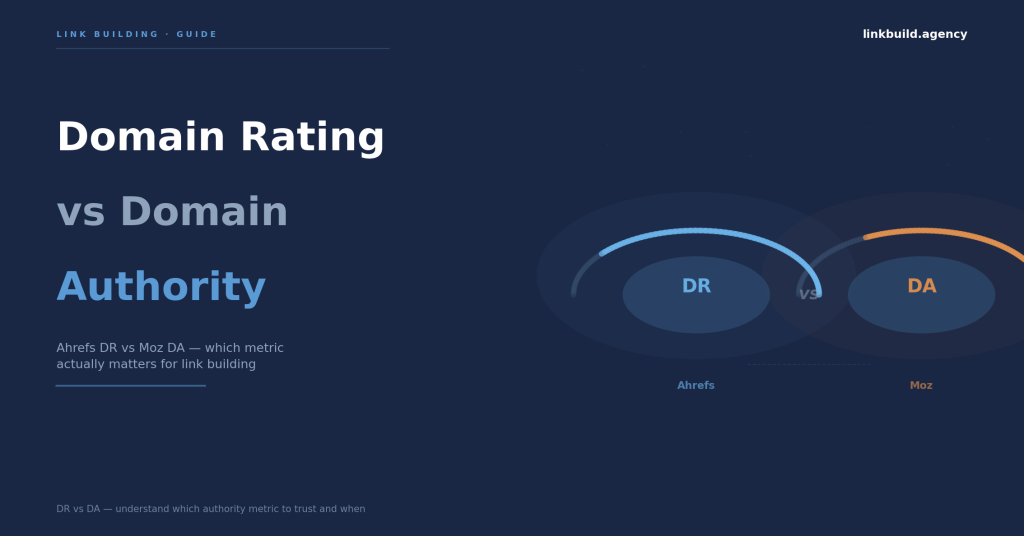
A Moz-created metric scored from 1 to 100, predicting how likely a domain is to rank in search results based on the quantity and quality of its backlinks. Higher scores suggest stronger ranking potential, though DA is a third-party approximation and not an official Google ranking signal.
Often Confused With: Domain Rating (DR)
Difference: DA is a Moz metric that estimates ranking potential, while DR is an Ahrefs metric focused primarily on backlink strength.
- Domain Rating (DR)
An Ahrefs metric scored from 0 to 100, representing the overall strength of a website’s backlink profile. Calculated on a logarithmic scale based on the quantity of referring dofollow domains and their own DR values, it is widely used as a proxy for link authority comparisons during prospecting.
- Duplicate Content
Content that is identical or highly similar to other content on the same or different websites can dilute link equity across multiple URLs and cause indexing confusion. Commonly resolved using canonical tags to consolidate signals, 301 redirects to merge pages, or noindex directives.
E
- E-A-T (Expertise, Authoritativeness, Trustworthiness)
A framework from Google’s Search Quality Rater Guidelines is used to evaluate content quality. While not a direct ranking factor, strong E-A-T, supported by authoritative backlinks, credible authorship, and citations from reputable sources, helps align content with the standards Google’s algorithm values most.
- E-E-A-T (Experience, Expertise, Authoritativeness, Trustworthiness)
An expanded E-A-T framework was introduced in Google’s December 2022 guidelines update, adding ‘Experience’ to emphasize first-hand knowledge. E-E-A-T is especially critical for YMYL content and is strengthened by earning backlinks from established, credible sources that vouch for an author’s real-world expertise.
- Editorial Links
Naturally placed hyperlinks where a content creator voluntarily links to a resource they found genuinely useful, with no payment or reciprocal agreement involved. Editorial links are the highest-quality backlinks in Google’s framework because they represent authentic third-party endorsement of content value and relevance.
Often Confused With: Guest Post Links
Difference: Editorial links are voluntarily given by publishers, while guest post links are acquired through content contributions and outreach.
- Ego Bait
Content that strategically features, quotes, or flatters specific individuals, brands, or experts to encourage them to share and link to the piece. Expert roundups, industry awards, and ‘best of’ lists are classic ego-bait formats used within link-building outreach campaigns.
- Email Outreach Templates
Pre-written email frameworks are used to contact website owners, editors, or bloggers about potential link placements, guest post contributions, or collaborations. Effective templates are customized per recipient, clearly communicate the value offered, and feel genuinely personal rather than automated, bulk-sent, or transactional.
- Evergreen Content
Content that remains relevant, accurate, and useful over a long period without frequent updates, such as how-to guides, tutorials, and comprehensive glossaries. Evergreen pieces are among the strongest linkable assets because they continuously attract new backlinks long after their original publication date.
- External Links
Links hosted on a website that point to pages on a different domain are also called outbound links. Citing authoritative external sources can improve a page’s own credibility in the eyes of both users and crawlers, and may encourage reciprocal acknowledgment from the websites being linked to.
Often Confused With: Backlinks
Difference: External links are links pointing out from a website, while backlinks are links pointing into a website.
F
- Flow Metric
A registered Majestic trademark describing the combined use of Trust Flow and Citation Flow to measure a website’s link quality and quantity. Both metrics are scored logarithmically from 0 to 100 and are used together to provide a comprehensive picture of any domain’s or URL’s backlink profile health.
- Follow-to-NoFollow Ratio
The proportion of dofollow links versus nofollow links within a site’s backlink profile. A natural profile contains a healthy mix of both, since nofollow links arise organically from social media, forums, and directories. An unnaturally high dofollow ratio can be a manipulation signal to search engines.
- Footer Links
Links appearing in the bottom section of a website are often displayed site-wide on every page. While useful for internal navigation, footer links to external sites are generally discounted by Google. Keyword-rich external footer links are frequently associated with manipulative link schemes and can harm SEO performance.
- Forum Backlinks
Links obtained through posts, replies, or signature sections in online discussion forums. Once a popular tactic, forum links have significantly declined in value as search algorithms evolved. Excessive forum link building without genuine engagement can now be treated as spam and ignored or penalized.
G
- GEO (Generative Engine Optimization)
Optimizing content so it appears in answers generated by AI systems (like chat-based or generative search engines). Instead of ranking in blue links, the goal is to be cited or used inside AI-generated answers.
- Google Analytics
A free web analytics platform by Google tracking website traffic, user behavior, referral sources, and conversions. While not a direct link-building tool, it helps evaluate the volume and quality of referral traffic generated by earned backlinks, indicating which link placements are driving genuine audience engagement.
- Googlebot
Google’s web crawler, also called a spider or robot, systematically visits and indexes web content by following links between pages. Googlebot’s crawling behavior makes internal and external link structure critically important for ensuring all important pages are discovered, indexed, and credited for incoming link equity.
- Google Penalty
A negative action applied to a website by Google, either manually by a quality reviewer or algorithmically, for violating its guidelines. Link-related penalties typically arise from unnatural backlinks, paid link schemes, or link farms, and can result in significant ranking drops or complete de-indexation.
- Google Penguin
A Google algorithm update launched in April 2012 targeting link spam and over-optimized anchor text distributions. Integrated into Google’s core algorithm in 2016, Penguin continuously devalues sites with manipulative link patterns rather than applying one-time penalties, making link profile health an ongoing concern.
- Google Search Console
A free Google tool allowing webmasters to monitor site performance, review manual actions, submit sitemaps, and upload disavow files. It displays a site’s backlink data and flags unnatural link warnings, making it an indispensable resource for link-building campaigns and penalty recovery efforts.
- Google Webmaster Guidelines
A set of rules and best practices published by Google to help site owners build websites that are properly indexed and fairly ranked. Link-related guidelines explicitly prohibit paid links, link schemes, link farms, cloaking, and PBNs, with violations risking penalties ranging from ranking drops to de-indexation.
- Guest Posting
Writing and publishing an article on another website in exchange for a contextual backlink to the author’s domain. An effective white hat link-building tactic is when content adds genuine value and the host site has strong editorial standards, topical relevance, and a real, engaged audience.
What We’ve Seen in Practice: The biggest difference between successful and unsuccessful guest posting campaigns is publisher quality. We’ve consistently seen better long-term results from placements on niche-relevant websites with engaged audiences than from high-volume campaigns focused primarily on authority metrics.
Often Confused With: Niche Edits
Difference: Guest posting involves publishing new content, while niche edits place links into existing content.
H
- HARO (Help a Reporter Out)
A journalist-source platform for earning editorial backlinks through expert commentary. Originally part of Cision, later rebranded as Connectively (discontinued in 2024), with the HARO brand now acquired by Featured.com. Similar alternatives include Featured and Qwoted.
- Hidden Links
Links coded into a webpage to be invisible to human visitors but readable by search engine crawlers, achieved through white-on-white text, zero font sizes, or CSS display tricks. A black hat technique explicitly prohibited by Google’s guidelines, hidden links risk severe manual or algorithmic penalties.
- Homepage Link
A backlink pointing specifically to a website’s main homepage rather than an inner page. While homepage links build overall domain authority, they do not directly boost individual inner pages. A link profile containing exclusively homepage links may appear unnatural and could attract algorithmic scrutiny.
- HTTP Status Code
A server response code indicating the result of a URL request. Key codes for link builders include 200 (success), 301 (permanent redirect), 302 (temporary redirect), 404 (page not found), and 410 (permanently gone), each affecting how link equity is handled and passed between pages.
I
- Image Links
Hyperlinked images where clicking directs users to another page, with the image’s alt text functioning as anchor text for SEO purposes. Commonly used in infographic distribution campaigns, badge placements, and logo attribution links. Descriptive, relevant alt text maximizes the topical value these links pass to search engines.
- Indexation
The process by which a search engine crawls, processes, and stores a webpage in its database for retrieval in search results. Proper link structures, clean site architecture, and a submitted XML sitemap collectively support faster and more complete indexation of pages targeted for link-building campaigns.
- Infographic
A visual representation of data, information, or processes combining text and graphics in a shareable format. Infographics are popular linkable assets because they are easy for publishers to embed with an attribution link, making them a passive source of contextual backlinks from relevant content creators.
- Infographic Link Building
A strategy of creating visually compelling infographics and distributing them with embed codes containing attribution links to earn backlinks. Widely used between 2010 and 2016, the approach remains viable for genuinely high-quality visuals, though the landscape is more competitive and the saturation is higher than before.
- Internal Links
Hyperlinks connect one page on a website to another page on the same domain. Strategic internal linking distributes authority across a site, improves crawlability and indexation, enhances user navigation, and helps search engines understand site architecture and the relative importance of individual pages.
- IP Address
A unique numerical identifier assigned to every device connected to the internet. In backlink analysis, multiple links from the same IP address or C-subnet may be treated as coming from a single source, reducing their combined value and flagging potential link network or farm behaviour.
K
- Keywords
Words and phrases users type into search engines to find information. In link building, keywords guide anchor text selection, identify content opportunities to attract relevant backlinks, and help determine which pages should receive link-building attention to improve their organic visibility for target search queries.
L
- Landing Pages
Web pages that a user first arrives at when clicking from an external source, such as a backlink, ad, or email. Ensuring target landing pages are optimized for both user experience and search engines maximizes the ranking and conversion benefit derived from the link equity they receive.
- Link Attribute
An HTML attribute applied to a hyperlink to indicate its nature and intent to search engine crawlers. The three main link attributes are rel=’nofollow,’ rel=’sponsored,’ and rel=’ugc,’ each communicating different information about whether a link is editorial, paid, or user-generated in origin.
- Link Bait
Content specifically designed to attract a high volume of inbound links through its inherent value, novelty, utility, or shareability. Examples include original research, controversial analyses, free tools, and comprehensive guides. Effective link bait continues to earn backlinks passively long after its initial publication and promotion.
- Link Building Agency
A company specializing in link acquisition as a professional service, managing prospecting, outreach, content creation, and placement on behalf of clients. Reputable agencies focus on editorial, contextual backlinks from relevant, authoritative sites, while lower-quality providers may rely on link farms or PBN-based placements.
- Link Building ROI
The return on investment from link-building activities is measured through improvements in rankings, organic traffic growth, and revenue impact. Calculating precise ROI is challenging because links compound in value over time and interact with many other ranking factors, requiring long-term tracking of referring domain growth against organic performance.
What We’ve Seen in Practice: The value of a backlink is rarely visible in isolation. We typically see the strongest ROI from campaigns that improve rankings across groups of related pages rather than focusing on a single keyword movement.
- Link Cloaking
A black hat technique displaying different link destinations to search engine crawlers than to human visitors, such as showing a dofollow editorial link to Googlebot while redirecting users through an affiliate URL. This directly violates Google’s cloaking guidelines and can result in severe ranking penalties.
- Link Decay
The natural process by which backlinks are lost over time is as pages are deleted, domains expire, or content is updated and references removed. Link decay makes link building an ongoing effort rather than a one-time task, requiring continuous acquisition to maintain and grow a site’s authority.
- Link Density
A measure of how much of the content surrounding a backlink consists of other links, expressed as a percentage. High link density is common in footers, navigation menus, and blogrolls. Low link density, meaning a link surrounded by paragraph text, generally indicates stronger editorial value.
- Link Earning vs. Link Building
The philosophical distinction between passively attracting links through outstanding content and actively pursuing them through outreach and tactical campaigns. The most effective SEO strategies combine both: creating assets worthy of being linked to and proactively promoting them to ensure the right audiences are aware of them.
- Link Equity
The value, authority, and trust transferred from a linking page to the target page through a hyperlink, also informally called link juice. Link equity is divided among all outbound links on a page, so pages with fewer external links pass more equity per individual link to their targets.
Often Confused With: PageRank
Difference: PageRank is Google’s algorithm, while link equity is the broader concept of authority and value passed through links.
- Link Exchange
An arrangement where two websites agree to link to each other. Small-scale, natural link exchanges between genuinely related sites are common and acceptable. However, systematic or large-scale link exchange programs are explicitly classified in Google’s guidelines as a manipulative link scheme, risking penalties.
Often Confused With: Three-Way Link Exchange
Difference: A link exchange involves two sites linking to each other, while a three-way exchange uses multiple sites to disguise reciprocity.
- Link Intersect (Link Gap Analysis)
A feature in SEO tools that identifies websites linking to competitors but not to your own domain. These sites have already demonstrated willingness to link to niche-relevant content, making them priority outreach targets with a higher likelihood of conversion than cold, untargeted prospect lists.
- Link Juice
An informal SEO term describing the ranking authority and trust value a hyperlink passes from the source page to the destination page. Pages with more high-quality inbound links accumulate more link juice, improving their ability to rank. Though unofficial, the term is universally understood across the SEO industry.
- Link Marketplace
A platform where publishers list available link placements and buyers can browse and purchase them by metrics, niche, and price. While marketplaces streamline link acquisition, purchased links technically require a rel=’sponsored’ attribute under Google’s guidelines to avoid being treated as a manipulative link scheme.
- Link Neighborhood
The collective group of other websites linked from the same page as your own backlink. Being associated with spammy, irrelevant, or low-quality sites in a link neighborhood can negatively affect how search engines perceive the trustworthiness and value of your own backlink on that page.
- Link Placement
The specific location on a page where a backlink is inserted. Links within the main body content of an article, especially earlier in the piece, are considered more editorially significant and pass greater link equity than those buried in footers, sidebars, author bios, or navigation sections.
- Link Profile
The complete collection of all backlinks pointing to a website, including anchor texts, referring domains, link types, follow status, and topical diversity. A healthy link profile appears naturally built over time with diversity in sources and anchors, while an unnatural one may trigger algorithmic or manual review.
- Link Prospecting
The process of identifying potential websites suitable for link building outreach by researching resource pages, guest post opportunities, competitor backlinks, broken links, and unlinked mentions. Thorough prospecting is the foundation of efficient link campaigns, ensuring outreach efforts are directed toward genuinely viable and relevant targets.
- Link Reclamation
The process of recovering links that have been lost or should exist but do not, including fixing broken backlinks through redirects, converting unlinked brand mentions into hyperlinks, and requesting restoration of links removed from previously published content through direct, personalized webmaster outreach campaigns.
Often Confused With: Broken Link Building
Difference: Link reclamation recovers existing or lost opportunities, while broken link building creates new opportunities from dead links on other websites.
- Link Relevance
The topical connection between the referring site or page and the target page being linked to. A highly relevant link from a contextually related source typically carries more ranking authority than an irrelevant one, even if the irrelevant site has considerably higher overall domain authority metrics.
What We’ve Seen in Practice: In competitive industries, we’ve often seen highly relevant niche links outperform stronger authority links from unrelated websites. Relevance influences both the editorial value of a link and the likelihood that it drives qualified referral traffic.
- Link Roundup
A periodically published blog post, typically weekly or monthly, that curates and links to the best content within a specific niche. Getting featured in niche link roundups is an efficient, low-friction outreach tactic for earning contextual backlinks from engaged audiences that are already interested in your topic area.
- Link Schemes
Practices explicitly prohibited by Google that are designed to artificially manipulate PageRank through unnatural link creation. Examples include buying and selling links, large-scale link exchanges, automated link building, PBN placements, sitewide footer link arrangements, and guest posting campaigns with keyword-optimized anchor text.
- Link Spam
Low-quality, manipulative backlinks created in bulk to game search rankings, typically through comment spam, automated directory submissions, forum profiles, and PBN placements. Google’s SpamBrain AI system is continuously updated to detect and neutralize link spam patterns before they can benefit the sites they target.
- Link Velocity
The rate at which a website acquires new backlinks over time. Natural link velocity shows gradual growth with occasional spikes during viral content or press coverage. Suddenly, artificial surges in acquisition can trigger algorithmic scrutiny because they deviate from the expected organic patterns of link growth.
What We’ve Seen in Practice: Link velocity becomes a concern when growth patterns look disconnected from the site’s actual visibility. We’ve seen sites acquire dozens of links in a short period without issues when backed by digital PR campaigns, original research, or product launches. What tends to attract scrutiny is aggressive link acquisition that lacks a corresponding reason for that growth.
- Linkable Asset
A piece of content so useful, insightful, or unique that other websites naturally want to link to it over time. Examples include original research studies, free tools, comprehensive guides, data visualizations, and templates. Linkable assets generate passive link acquisition continuously after their initial publication and promotion.
What We’ve Seen in Practice: Original data studies, industry statistics pages, and unique research consistently attract more natural backlinks than generic blog content. The most successful linkable assets usually solve a problem or provide information that other publishers want to reference repeatedly.
Often Confused With: Link Bait
Difference: A linkable asset provides lasting value and naturally attracts links, while link bait is often created specifically to generate attention and backlinks.
- Linking Domains
The total number of unique domains containing at least one link pointing to a target website. Distinct from raw backlink count, linking domains measure the breadth and diversity of a site’s endorsement sources. A higher number of unique linking domains is generally weighted favorably by search engine algorithms.
Often Confused With: Referring Domains
- Listicle (List Post)
A content format cataloging multiple items around a topic, such as ‘Top 10 SEO Tools for 2025.’ Listicles are popular linkable assets and are widely used in outreach campaigns to feature third-party products or experts, who are then more likely to link back to the piece in which they appear.
- LLM (Large Language Model)
An AI system trained on vast text data to understand, generate, and respond to human language in a coherent, context-aware manner.
- LLMO (Large Language Model Optimization)
A process of improving content, structure, and signals so large language models better understand, retrieve, and accurately represent information in responses.
- LLMS.txt
A simple, standardized Markdown file located at a website’s root that guides AI crawlers and models. It functions like an “AI sitemap,” helping large language models (LLMs) discover, interpret, and reference the site’s key content more effectively.
- Local Citations
Online mentions of a business’s Name, Address, and Phone number (NAP) on local directories, review platforms, and community blogs. Accurate and consistent local citations are critical for local SEO, helping search engines verify business legitimacy and improve visibility within local map packs and geographically targeted search results.
M
- Manual Penalty (Manual Action)
A penalty applied by a Google employee who has reviewed a site and determined it violates quality guidelines. Shown in Google Search Console under ‘Manual Actions,’ link-related penalties require removing or disavowing harmful links and submitting a formal reconsideration request to have the action lifted.
Often Confused With: Algorithmic Penalty
Difference: Manual penalties are applied by human reviewers and appear in Search Console, while algorithmic penalties occur automatically through ranking systems.
- Mobile-First Indexing
Google’s practice of primarily using the mobile version of a website for crawling, indexing, and ranking. While not a direct link-building concept, mobile-optimized site architecture ensures that newly earned backlinks and newly published pages are discovered and indexed as efficiently as possible by Googlebot.
N
- Negative SEO
The malicious practice of deliberately building toxic or spammy backlinks to a competitor’s website to trigger a Google penalty and damage their rankings. The effectiveness of negative SEO is debated; Google’s SpamBrain system helps defend against it, and the disavow tool provides an additional line of protection.
- Niche Edit (Link Insertion)
A link-building tactic is placing a hyperlink into an already-published, existing article on an external website. Because the target page often already has established authority and organic traffic, niche edits can deliver strong topical signals. However, paying for insertions is a link scheme violation under Google’s guidelines.
What We’ve Seen in Practice: Not all niche edits are equal. We’ve found that links added to genuinely relevant articles with existing traffic tend to outperform placements on pages created solely for selling links. Before evaluating a niche edit opportunity, we typically look at topical relevance, traffic stability, and editorial quality rather than relying on authority metrics alone.
- Noise Anchors
Generic, low-information anchor text phrases such as ‘click here,’ ‘this website,’ or ‘read more’ that provide minimal topical context to search engines. While individually low-value, noise anchors contribute to a natural-looking backlink profile by mimicking genuine editorial behaviour and reducing over-optimisation signals.
- Nofollow Links
Links carrying the rel=’nofollow’ HTML attribute, historically instructing search engines not to pass PageRank through the link. Since 2019, Google treats nofollow as a hint rather than a directive, meaning some nofollow links may still contribute indirect ranking value, indexing support, or referral traffic benefits.
Often Confused With: Sponsored Links and UGC Links
Difference: Nofollow is a general hint to search engines, Sponsored identifies paid placements, and UGC identifies user-generated content.
- Noopener / Noreferrer
HTML link attributes are often added to links opening in new browser tabs. ‘Noopener’ prevents the new page from accessing the original page’s window for security reasons. ‘Noreferrer’ suppresses browser referrer data. Neither attribute directly affects link equity, SEO crawling, or PageRank distribution between pages.
O
- Off-Page SEO
All optimization activities are performed outside a website to build external authority and relevance signals. Link building is the most significant off-page SEO discipline, but brand mentions, digital PR campaigns, social signals, and influencer relationships also contribute to a site’s overall external authority and trustworthiness.
- On-Page SEO
Optimization activities performed directly on a website’s own pages to improve search rankings, including keyword usage, meta tags, heading structure, internal linking, content quality, and technical performance. Strong on-page SEO maximizes the ranking benefit that a site derives from the backlinks it earns through external efforts.
- Open Rates
The percentage of recipients who open an outreach email relative to the total number sent. In link building, open rates are a key performance indicator for campaign health, reflecting the effectiveness of subject lines, sender names, timing, and the perceived relevance of the outreach pitch to its recipients.
- Orphan Page
A webpage that has no internal links pointing to it, making it inaccessible through normal site navigation. Orphan pages receive no internal link equity from the rest of the domain, are rarely crawled by search engines, and have diminished SEO value even when they receive external backlinks.
- Outreach
The process of contacting website owners, editors, journalists, or bloggers to request a link, pitch a guest post, propose a content collaboration, or suggest replacing a broken link. Personalized outreach that clearly communicates value is the primary engine driving placements in most active link-building campaigns.
P
- Page Authority (PA)
A Moz-created metric scored from 0 to 100, predicting how well a specific page will rank in search results based on the quantity and quality of inbound links pointing to that individual URL. It complements Domain Authority by providing a page-level view of link strength and ranking potential.
Often Confused With: Domain Authority (DA)
Difference: PA measures the ranking strength of a specific page, while DA evaluates an entire domain.
- PageRank
Google’s foundational algorithm, developed by co-founder Larry Page, evaluates webpage importance by analyzing the quality and quantity of inbound links. Though publicly displayed Toolbar PageRank was retired in 2016, an evolved internal version continues to operate as one of Google’s core ranking signals.
- PageRank Sculpting
A practice involving the use of nofollow attributes on internal links to concentrate PageRank flow toward the most important pages. Google has confirmed this approach no longer functions as intended, since equity assigned to nofollowed internal links is simply lost rather than redistributed to followed links elsewhere.
- Paid Links
Backlinks acquired in exchange for monetary payment, explicitly violating Google’s guidelines, unless marked with the rel=’sponsored’ attribute. Paid links intended to manipulate PageRank are classified as a link scheme. Detection can result in manual penalties for both the buyer’s and the seller’s domains.
- Parasite SEO
Publishing content on high-authority third-party platforms to rank for competitive keywords and funnel traffic or links back to a main domain. Google’s 2024 site reputation abuse policies specifically targeted this tactic, devaluing hosted low-quality content that exploits a legitimate platform’s domain authority.
- PBN (Private Blog Network)
A network of websites owned or controlled by a single entity exclusively for the purpose of building backlinks to target domains. PBNs are a direct violation of Google’s guidelines. When identified, the network sites and all domains they link to can face severe manual or algorithmic penalties.
- Position Tracking
The ongoing monitoring of where a website ranks for specific target keywords across search engines over time. In link building, position tracking helps measure whether newly acquired backlinks are translating into tangible ranking improvements for the pages receiving the link-building attention and investment.
Q
- Query
A word or phrase is entered into a search engine to retrieve relevant information from its index. Understanding user queries guides link builders in identifying what content to create to attract backlinks and which pages should receive link-building investment to improve their organic search visibility.
R
- Rankings
A website’s position in the SERPs for a given search query directly influences organic visibility, click-through rates, and traffic volume. Link building is one of the most impactful factors for improving rankings, with more authoritative, relevant, and diverse backlink profiles generally correlating with higher placements.
- Reciprocal Links
A linking arrangement where two websites link to each other, commonly described as ‘you link to me, I link to you.’ While occasional reciprocal linking between related sites is natural and acceptable, large-scale systematic reciprocal link programs are classified by Google as a manipulative link scheme.
- Reconsideration Request
A formal submission through Google Search Console asking Google to review a site following a manual penalty. The request must explain what violations occurred, detail the remediation steps taken, and provide commitments to future compliance. Google then reviews the request and either lifts or upholds the manual action.
- Redirect
A server instruction sends users and search engine crawlers from one URL to another location. Critical in link building for preserving link equity when pages move, or domains migrate, with 301 redirects passing the majority of equity to the destination, and 302 redirects indicating a temporary move.
- Redirect Chain
A sequence of consecutive redirects where one URL redirects to another, which redirects to another, and so on. Each additional hop in a redirect chain can dilute the link equity passed through. Keeping chains to a single hop preserves the maximum value from all incoming backlinks to those URLs.
- Referring Domains
The total number of unique websites containing at least one link pointing to a target domain. Distinct from raw backlink count, referring domains measure the breadth and diversity of a site’s endorsement sources, with a higher number of unique referring domains generally being a stronger authority indicator.
Often Confused With: Backlinks, Linking Domains
Difference: Referring domains count unique websites linking to you, while backlinks count every individual link.
- Resource Pages
Dedicated web pages curate lists of useful links, tools, and references around a specific topic. Resource page link building involves identifying relevant pages in your niche, ensuring your content genuinely belongs among the listed resources, and pitching its inclusion through personalized, value-focused outreach emails.
Often Confused With: Directories
Difference: Resource pages are curated editorial collections of useful content, while directories are structured listings of businesses or websites.
- Robots.txt
A text file located in a website’s root directory provides instructions to web crawlers about which pages or sections should not be crawled. Misconfigured robots.txt files can inadvertently block important pages from being indexed, preventing search engines from properly attributing link equity to those pages.
S
- Scholarship Link Building
A tactic involving the creation of a scholarship program to earn .edu backlinks from university financial aid pages listing the award. Once considered highly effective due to perceived .edu link authority, the strategy has significantly declined as many institutions have stopped linking to commercial scholarship pages.
- Search Engine Optimization (SEO)
The practice of optimizing a website’s content, technical architecture, and backlink profile to improve its visibility and rankings in organic search results. Link building is one of SEO’s most impactful pillars, working alongside on-page optimization and technical improvements to create a comprehensive search visibility strategy.
- Search Operators
Special characters, words, or syntax used in search engine queries to filter and refine results beyond standard keyword searches. Widely used in link building prospecting to find guest posting opportunities, broken links, competitor backlinks, and resource pages through targeted, operator-modified search strings.
- Second-Tier Links
Backlinks pointing to the pages that already link to your target site, boosting the authority of your first-tier backlinks by strengthening the referring pages themselves. By increasing the link equity of pages that link to you, second-tier linking amplifies the overall authority your target domain receives.
- SERM Link Building
Search Engine Reputation Management link building, which involves building backlinks to positive content about a brand to push unfavorable results further down in the SERPs. This legitimate application of link building focuses on proactively shaping the narrative surrounding a brand’s name in organic search results.
- SERPs (Search Engine Results Pages)
The pages displayed by a search engine in response to a user query, showing ranked organic results, paid ads, featured snippets, local packs, and other rich features. Link building directly influences a site’s organic placement within SERPs by strengthening its authority and relevance signals for target queries.
- Sidebar Link
A link is placed in the sidebar area of a website, typically appearing on every page where the sidebar is displayed. Because sidebar links are effectively sitewide, search engines assign them reduced individual value compared to contextual in-content links. Keyword-rich external sidebar links are often treated as a spam signal.
- Sitewide Links
Links appearing on every page of a website, commonly found in navigation menus, footers, or sidebars. Though a single sitewide placement can generate thousands of backlinks numerically, search engines consolidate these as one effective link. Excessive keyword-rich sitewide external links are flagged as potentially manipulative.
- Sitemaps
Files listing all pages on a website that the webmaster wants search engines to crawl and index, submitted through tools like Google Search Console. Sitemaps help search engine bots efficiently discover all important pages, ensuring new content receiving backlinks is indexed quickly for search visibility.
- Skyscraper Technique
A link-building strategy involving finding highly linked existing content, creating a demonstrably superior version, then contacting the sites linking to the original and suggesting your improved resource as a replacement. The technique works best when the new content genuinely offers more depth, currency, or utility.
- Spam
Unsolicited, irrelevant, or manipulative content designed to game search rankings or communication systems rather than provide genuine user value. In link building, spam refers to mass low-quality links created through automated tools, comment spam, or link farms, which search engines actively detect and ignore or penalize.
- Spam Score
A Moz metric indicating how likely a domain is to have low-quality or manipulative characteristics, based on a range of signals associated with spammy behavior. A high spam score acts as a warning flag during backlink prospecting and audits, though it does not automatically confirm a site is toxic.
- SpamBrain
Google’s AI-powered spam detection system that identifies and neutralizes link spam at scale by continuously learning to recognize patterns associated with manipulative link schemes. SpamBrain detects both spammy links pointing to a site and the sites that participate in buying or selling unnatural links.
- Sponsored Links
Links placed or obtained in exchange for monetary or material compensation, which Google requires to carry the rel=’sponsored’ attribute to disclose their commercial nature. Failure to properly label paid links exposes both the buyer and the seller to potential link scheme penalties from Google’s quality team.
Often Confused With: Paid Links
Difference: Paid links become sponsored links only when properly disclosed using the rel=”sponsored” attribute.
- Subdomain
A domain that forms part of a larger primary domain, created by adding a prefix label (e.g., blog.example.com). In SEO, the relationship between subdomains and their root domain authority varies by tool and context. Backlinks pointing to subdomains may or may not contribute equally to the root domain’s authority.
T
- Three-Way Link Exchange
A more sophisticated reciprocal linking variant where Site A links to Site B, B links to Site C, and C links to Site A, creating an indirect circular link pattern. Google has explicitly identified and warned against this practice as a manipulative link scheme in its quality guidelines.
- Tiered Link Building
A strategy building backlinks not only to a target site but also to the pages that already link to it, creating tiers of link support. Tier 2 links point to tier 1 referring pages to boost their authority. Depending on execution, this is considered a grey-to-black hat tactic by most SEOs.
- Top-Level Domain (TLD)
The highest-level segment of a domain name appearing after the final dot, such as .com, .org, .edu, or .co.uk. While some TLDs were historically associated with greater authority, modern SEO prioritizes overall site quality, topical relevance, and the genuine editorial nature of the referring domain over its TLD.
- Topical Authority
The concept that consistently building backlinks from niche-relevant sites within a specific topic cluster strengthens a domain’s perceived expertise over that entire subject area. Prioritizing topically aligned referring domains over random high-authority placements is increasingly central to effective, future-proof SEO strategy.
Often Confused With: Domain Authority
Difference: Topical authority reflects expertise in a specific subject area, while domain authority attempts to estimate overall ranking strength.
- Topical Trust Flow
A Majestic metric categorizing a website’s link authority across specific industries and topic niches, scored logarithmically from 0 to 100. It helps link builders assess their own topical positioning and evaluate whether a prospective referring domain has genuine authority and relevance in a specific subject area.
- Toxic Backlinks
Backlinks from spammy, irrelevant, or manipulative sources can harm rather than help a site’s organic rankings. Toxic links often originate from link farms, PBNs, or hacked sites. They are identified through backlink audits and can be neutralized by submitting a disavow file to Google Search Console.
What We’ve Seen in Practice: Many site owners overestimate the impact of individual low-quality links. During audits, we focus more on identifying clear patterns of manipulation than isolated spam links, as Google has become increasingly effective at ignoring low-value signals.
- Traffic
The total number of visitors to a website over a given period, categorized as organic, direct, referral, social, or paid. In link building, referral traffic generated by backlinks demonstrates real-world audience value beyond SEO contribution, indicating the quality and relevance of the referring site’s readership.
- Transactional Keywords
Keywords indicating a user’s clear intention to complete a purchase or engage a service, marked by verbs like ‘buy,’ ‘hire,’ or ‘order.’ These high-conversion queries are key targets for landing page optimization and link-building campaigns focused on driving commercial traffic and improving revenue-related search rankings.
- Trust Flow
A Majestic trademark metric scored from 0 to 100, measuring the quality and trustworthiness of a site’s backlink sources based on their distance from a curated set of manually reviewed, highly trusted seed sites. Higher Trust Flow indicates the site earns links predominantly from reputable, authoritative sources.
Often Confused With: Citation Flow
Difference: Trust Flow emphasizes link quality, while Citation Flow emphasizes link volume.
U
- UGC Link (User-Generated Content Link)
A link attribute (rel=’ugc’) was introduced by Google in 2019 for links appearing within user-generated content, such as forum posts, blog comments, or community contributions. It signals that the site owner did not editorially place the link, helping Google differentiate organic endorsements from community-generated placements.
- Unlinked Mentions
Instances where a brand, product, or website is referenced in external content without an accompanying hyperlink. Unlinked mentions are prime candidates for link reclamation outreach, as the author has already demonstrated awareness of the brand, resulting in significantly higher conversion rates than completely cold prospecting.
- Unnatural Links
Backlinks created artificially to manipulate search engine rankings rather than to provide genuine value to readers, including paid links, PBN placements, link farm content, and excessively keyword-optimized anchors. Google’s algorithms are specifically designed to detect and devalue or penalize unnatural link patterns at scale.
- URL (Uniform Resource Locator)
The unique web address identifies the specific location of a resource on the Internet. In link building, the target URL receiving a backlink is central to all strategy decisions, as the strength of each URL’s backlink profile directly influences its ability to rank for relevant queries.
- URL Rating (UR)
An Ahrefs metric scored from 0 to 100, measuring the backlink strength of a specific page rather than the entire domain. Pages with higher URL Ratings rank more competitively. When assessing link opportunities, the UR of the specific linking page is often more informative than domain-level authority metrics alone.
Often Confused With: Domain Rating (DR)
Difference: UR measures the backlink strength of a specific page, while DR measures the strength of the entire domain.
V
- Visibility Flow
A Majestic metric combining Trust Flow and Link Density to estimate how visible a particular link is to both users and crawlers. It favors low-density, editorially placed links on high-Trust Flow pages while discounting links found in heavily linked areas like headers, footers, and navigation menus.
W
- Wayback Machine
An internet archive tool by the Internet Archive that stores historical snapshots of web pages from various dates. Link builders use it to investigate deleted pages, verify past link placements, analyze historical site content, and identify redirect paths that may be leaking or misrouting link equity.
- White Hat SEO
SEO techniques and link-building strategies fully comply with search engine guidelines while prioritizing genuine value for users. White hat link building includes editorial outreach, guest posting on reputable sites, digital PR, and creating naturally link-worthy content assets designed to generate sustainable, long-term organic growth.
Often Confused With: Black Hat SEO
Difference: White hat SEO follows search engine guidelines, while black hat SEO relies on manipulative tactics that risk penalties.
- Widget
An embeddable piece of interactive code placed on external websites, often containing an attribution link back to the creator’s site. While widgets can passively generate many backlinks, search engines have grown skeptical of widget-based links that appear primarily for SEO gain rather than genuine functional utility.
X
- XML Sitemap
A structured file written in XML markup listing all pages on a website that webmasters want search engines to crawl and index. Submitting an XML sitemap through Google Search Console ensures that newly created pages receiving backlinks are discovered and indexed efficiently, maximizing the benefit of link-building campaigns.
Y
- Yandex
Russia’s dominant search engine and one of Europe’s largest, operating with its own distinct ranking algorithm separate from Google. For link builders targeting Russian-speaking markets, Yandex has specific guidelines around link quality and applies its own penalties for unnatural link manipulation and paid link schemes.
- Your Money or Your Life (YMYL)
Google’s classification for content covering topics that significantly impact a person’s health, finances, safety, or legal standing. YMYL pages are held to the highest E-E-A-T standards, making backlinks from credible, established, authoritative sources especially critical for ranking in these highly scrutinized content categories.
Z
- Zero-Click Search
A search result where users receive the information they need directly on the SERP without visiting a website. As AI Overviews, featured snippets, and knowledge panels expand, zero-click searches increasingly affect organic traffic and link-building ROI.
- Zombie Pages
Low-value pages that generate little to no traffic, backlinks, conversions, or engagement. During SEO audits, zombie pages are often consolidated, redirected, or removed to strengthen overall site quality and concentrate link equity on higher-performing content.
- Zero-Volume Keywords
Keywords that SEO tools report as having little or no monthly search volume. Despite limited data, these terms can attract qualified traffic, earn backlinks, and reveal niche search intent that larger keyword datasets may overlook.
0-9
- 301 Redirect
A permanent HTTP redirect sends users and crawlers from one URL to a new destination, passing the majority of the original page’s link equity to the target URL. Essential for preserving backlink value during URL changes, site migrations, or the consolidation of duplicate pages under a single canonical address.
- 302 Redirect
A temporary HTTP redirect sends users to a different URL while indicating the original URL remains the permanent address. Unlike a 301, a 302 was historically believed not to pass full link equity. Google now treats many 302s similarly to 301s, though a 301 is still preferred for permanent URL changes.
- 404 Error
An HTTP response code indicating that a requested page could not be found on the server. In link building, 404 errors represent both a problem, lost link equity from broken incoming backlinks, and an opportunity, forming the foundation of broken link building campaigns that recover or redirect that lost value.