You open a link-building prospect in Ahrefs, and DR is 65. Looks solid. Then you check it in Moz, and DA is 28. Which number should you trust?
Domain Rating (DR) and Domain Authority (DA) are the two most widely used website authority metrics in SEO, yet they come from different companies, measure different things, and regularly disagree with each other.
Treating them as the same thing is one of the most common and costly mistakes in link-building.
In this guide, we will walk you through exactly how each metric works, where each one breaks down, what manipulation looks like in 2026, and how to make smarter link decisions using signals that no third-party tool can fake.
DR vs DA at a Glance: Quick Answer
Domain Rating (DR) is Ahrefs’ score for the strength of a site’s backlink profile. Domain Authority (DA) is Moz’s prediction of how likely a site is to rank in Google.
| Metric | Domain Rating | Domain Authority |
|---|---|---|
| Creator | Ahrefs | Moz |
| Measures | Backlink profile strength | Predicted ranking ability |
| Core signal | Unique referring domains + outbound link count | Machine learning model across 40+ factors |
| Scale | 0-100, logarithmic | 1-100, logarithmic |
What Is Domain Rating?
Domain Rating is a proprietary metric by Ahrefs. It shows the relative strength of a website’s backlink profile on a scale from 0 to 100. The closer you get to 100, the stronger your link profile relative to every other domain in Ahrefs’ index.
DR is an Ahrefs metric based on a site’s backlink profile and is not a direct measure of overall quality or rankings. It ignores traffic, content quality, domain age, and link spam entirely.
Your DR does not exist in isolation. If other sites gain stronger backlink profiles and your site stays flat, your DR can drop, even if you have not lost a single link.
How Domain Rating Is Calculated
Ahrefs calculates DR much like Google’s PageRank, except between whole domains instead of pages.
The process runs roughly in four steps:
- Find all the domains with at least one followed link pointing to your site.
- Look up how many other unique domains each linking domain points to.
- Calculate the ‘link juice’ each domain passes. A high DR site that links to ten domains passes far more juice per link than a high-DR site that links to thousands of domains.
- Sum the juice, apply a logarithmic scale, and plot the result relative to all other sites in Ahrefs index.
Tim Soulo, CMO of Ahrefs, stated that “only 0.007% of all domains in the Ahrefs database have a DR of 80+, roughly 15,000 out of 207.4 million unique domains.”
What Factors Influence DR Scores?
Multiple links from the same domain do not stack. DR rewards the number of unique referring domains, not the link volume.
Four things drive your DR as follows:
- Referring domains: The count of unique sites linking to you matters more than total backlinks.
- Authority of those domains: A link from a strong site carries more weight than ten links from weak ones.
- Link selectivity: It’s essentially the number of other sites your linkers also point to, which reduces the value passed through each link.
- Followed links only: Nofollow, UGC, and sponsored links do not count toward DR. Only dofollow links from unique referring domains move the needle.
What Is Domain Authority?
Domain Authority is a metric created by Moz. It predicts how likely a website is to appear in Google search results relative to its competitors. It models ranking ability, not just links.
Unlike DR, which focuses exclusively on backlink profile strength, DA is designed to approximate Google’s overall evaluation of a domain.
How Domain Authority Is Calculated
Since the Domain Authority 2.0 update in March 2019, Moz uses a machine-learning model that predicts how often Google uses a domain in its results, then scales that from 0 to 100.
The machine learning model is explicitly trained on examples of manipulative link patterns. Sites with high spam scores from their linking domains face penalties in the DA model.
DA is also a relative metric. If Moz discovers large amounts of new links pointing to other domains in its index, your DA can drop without any change to your own backlink profile.
What Factors Influence DA Scores?
Some of the primary components used by Moz for evaluation are as follows:
- Linking root domains: The number of unique domains linking to your site.
- Link quality and spam signals: Moz penalizes domains linked to by sites showing spammy characteristics.
- Link profile diversity: Links from many different types of domains signal a more natural profile, but they should be relevant.
- Predicted SERP performance: Moz measures which domains appear most frequently in the actual Google SERP and calibrates DA so that those domains score higher.
Domain Rating vs Domain Authority: Key Differences
The DR vs DA difference is actually measurement vs prediction. DR counts your links, and DA guesses your ranking power.
| Metric | Domain Rating | Domain Authority |
|---|---|---|
| Core question | How strong is your link profile? | How likely are you to rank? |
| What it counts | DoFollow links from unique domains only | Machine-learning-based prediction using multiple link signals |
| Data source | Ahrefs backlink index | Moz Link Explorer |
| Method | PageRank-style link graph | Machine learning prediction |
| Update speed | Near real-time, daily | Roughly monthly |
| Primary use case | Link prospecting, backlink gap analysis | Ranking strength, competitor benchmarking |
| Manipulation risk | High, DR 50+ achievable for $50 via black-hat links | Moderate. Harder to inflate but still possible |
Never compare a DR number to a DA number directly. A DR 60 and a DA 60 are not equivalent. Compare each metric only against the site measured by the same tool.
The DR-to-Traffic Ratio Test: A Better Way to Evaluate Websites
When we grew a sports-niche client from DR 0 to DR 42, we never bought a link. Each one came from a relevant sports publication or from a high-DR site that linked naturally after we published original statistical reports.
The DR rose because there were real audiences behind those links, which is exactly what separates earned authority from a manufactured score.
That gap is what this test exposes. The idea is simple: compare a site’s DR against its actual organic traffic.
A site with DR 60 and 200 monthly organic visitors is almost certainly working with manipulated links, while a site with DR 40 and 80,000 monthly visitors has real editorial authority. The second site is a far better link prospect, even though its DR score is low.
Which Is More Important for SEO: DR or DA?
The honest answer is: neither is important in isolation, and both serve different purposes. The question should not be ‘which is better?’ but ‘which is right for this specific decision?’
Use DR when you are doing link prospecting. It updates frequently, reflects Ahrefs’ massive link index, and gives you a fast read on a site’s raw backlink profile strength.
Use DA when you are doing competitive analysis and want to understand a site’s overall ranking potential. As DA incorporates spam signals and tries to model Google’s algorithm, a site with a high DA is more likely to be a site Google actively trusts.
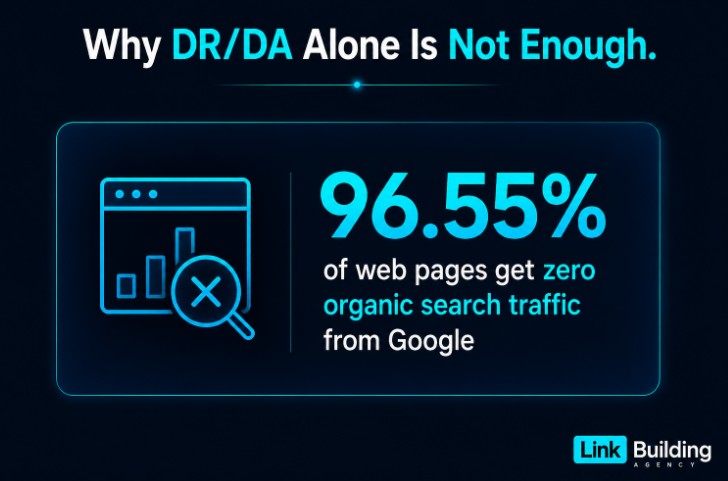
Neither metric, however, should ever be the sole reason you pursue or reject a link opportunity. Around 96.55% of all pages get zero search traffic from Google, and a significant portion of those zero-traffic pages have non-zero DR and DA.
Source: Ahrefs
Does Google Use Domain Rating or Domain Authority?
No. Google does not use DR or DA as ranking factors. Both are scores built by SEO companies, not signals inside Google’s algorithm.
What Google Representatives Have Said
In June 2019, an X (formerly Twitter) user asked John Mueller if a traffic drop was related to a change in the domain authority score. He replied:
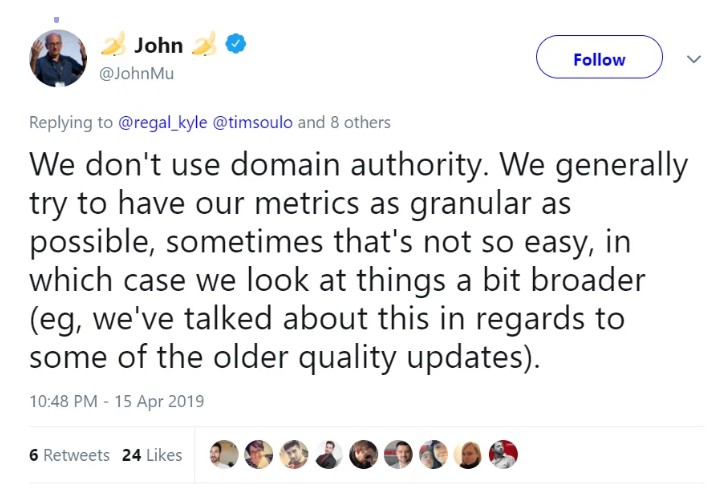
In 2022, a Reddit commenter asked Mueller his view on DA. He responded, “I don’t think I’ve ever looked up the DA for a site in the 14 years I’ve done this.”
Source: Reddit
Ahrefs’ own support documentation states that “There’s no evidence that search engines use Domain Rating as a ranking factor at all.”
Understanding Google’s Actual Authority Signals
Google uses hundreds of signals at the page and site level, but none of them map directly to DR or DA. What Google cares about, based on confirmed ranking factors and API documentation:
1. PageRank: Andrey Lipattsev confirmed in 2016 that backlinks from individual pages are one of Google’s strongest ranking factors. This is page-level, not domain-level.
Source: Search Engine Land
2. Site-wide quality signals: Mueller has acknowledged that Google uses site-wide signals for new URLs. These are Google’s own internal measurements, not third-party scores.
Source: Search Engine Roundtable
3. E-E-A-T signals: Experience, Expertise, Authoritativeness, and Trustworthiness are evaluated at both page and domain level, through signals that Google measures itself.
Source: Google
4. The 2024 Google Content Warehouse API leak revealed specific attributes, including ‘siteFocus’ and ‘siteRadius,’ which measure how concentrated a site is around its core topics. This is topical authority, not DR or DA.
Source: SparkToro
Do DR and DA Still Matter in the Age of AI Search?
AI-powered search is changing how visibility works. Google AI Overviews, ChatGPT browsing, Perplexity, Claude, and Gemini all surface answers from external sources.
This has resulted in a question every SEO is asking: Does your DR or DA help you get cited in AI citations?
The short answer: DR and DA do not directly influence AI citations. But the underlying factors that produce high DR and DA, specifically editorial credibility and brand recognition, do correlate with AI citation frequency.
Do High-Authority Sites Appear More Often in AI Overviews?
The 5WPR AI Platform Citation Source Index 2026, which synthesized more than 680 million individual citations across AI platforms, found that the top 15 domains capture 68% of all consolidated AI citation share.
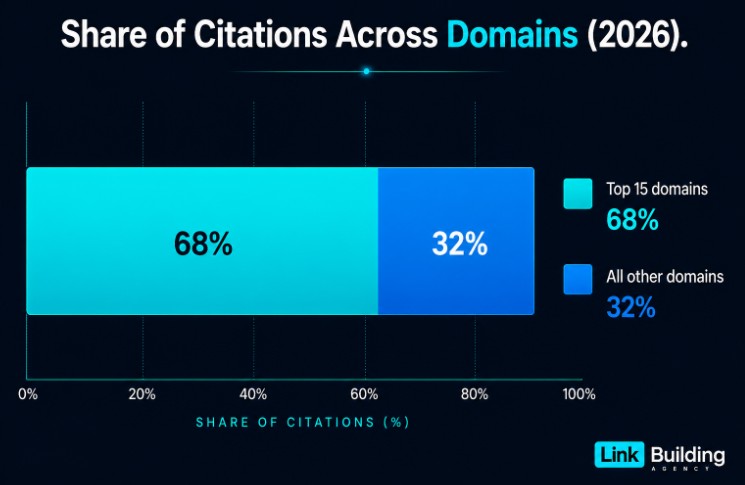
That level of concentration is greater than Google PageRank ever produced. Every domain in that top 15 would score extremely high on both DR and DA.
Do DR and DA Correlate With ChatGPT, Perplexity, and Gemini Citations?
Ahrefs’ analysis of 75,000 brands in 2025 found that branded web mentions correlate 3x more strongly with AI Overview visibility (r=0.664) than with traditional backlink metrics (r=0.218).
The Yext study of 17.2 million AI citations found that each AI engine picks sources differently.
- Gemini, which runs through Google search infrastructure, rewards technical SEO signals.
- ChatGPT rewards broad distribution.
- Perplexity rewards niche-specific directory presence and fresh data.
None of them uses DR or DA directly.
What AI Search Seems to Reward Instead
Based on the citation studies, AI systems favour:
- Original citable data, survey results, proprietary datasets, and benchmark studies become go-to references for both journalists and AI systems.
- When your content is well-structured, easy for machines to read, marked up clearly, and built on an architecture that’s simple to crawl, AI systems find it much easier to index your work and give it proper credit.
- Brand mention frequency across trusted third-party sources. Being named in Forbes, Wikipedia, Reddit, or industry publications repeatedly signals credibility to retrieval systems.
- Topical depth and coherence. Sites that comprehensively cover a subject area rather than skimming across many topics appear more often in niche AI queries.
None of the above factors is something DR and DA measure directly. They are, however, the natural outputs of an SEO strategy that builds genuine authority rather than chasing third-party scores.
The Biggest Problem With DR Today: Metric Manipulation
DR has a credibility problem because it counts links and ignores traffic, which can be inflated cheaply and quickly. An entire freelance economy exists to do exactly that.
On average, it took about $50 to push a new site to DR 50, and one hit DR 50 for just $15. The links were spam from single-page domains.
Source: Xamsor
Understanding the manipulation vectors helps you spot them in the wild.
Expired Domain Networks
Operators buy expired domains that still hold old links, then point them at a target. The borrowed authority inflates DR without any real audience behind it.
Google’s 2024 update specifically targeted expired domain abuse, with manual actions issued against sites using repurposed domains across unrelated niches. However, the DR score of those sites often stayed elevated even after Google deindexed their content.
Redirect Manipulation
A site stacks 301 redirects from several expired domains into one, funneling all that link equity into a single DR number.
Ahrefs claims to filter some of these from its DR calculation, but Moz’s DA can still be influenced.
Parasite SEO and Authority Hijacking
Parasite SEO means publishing content on high-authority platforms (Forbes, Medium, LinkedIn, government subdomains) that you do not own, then pointing links from that content to your target site.
Forbes Advisor received manual action warnings from Google in late 2024 under its Site Reputation Abuse policy. This illustrates that even genuinely high-DA/DR platforms can host content that Google eventually deprioritises or penalises.
Source: Search Engine Roundtable, X
Paid DR Inflation Services
There is a functioning black market, openly discussed on Reddit and documented by Xamsor and others, where you can purchase a DR 50+ site for as little as $50–$100.
These sites are sold for guest posting, link placement, or to inflate the perceived authority of a portfolio.
How to Spot a Fake DR Site
When vetting a site for a link, you can follow the checklist below:
- Traffic vs DR mismatch: A site with DR 50+ with fewer than 2,000 monthly organic visitors is a strong signal of manipulation.
- Sudden link spikes: A site that went from 20 to 400 referring domains in 30 days almost certainly used a link scheme or redirect.
- Niche mismatch: If a “cooking blog” has most of its backlinks from finance and gambling sites, the profile is manufactured.
- Anchor text overload: If 40% of anchors are “best [product] 2025,” the profile is manipulated.
Domain Rating vs Domain Authority for Modern Link Building
Link building in 2026 means navigating a market full of inflated scores, penalty-hit sites, and AI-generated content appearing as editorial authority. Both DR and DA remain part of the toolkit, but how you use them has changed.
Which Metric Should You Check Before Getting a Backlink?
Check DR first as a quick filter, then verify with traffic data, then use DA as a secondary spam check. If DR and DA diverge significantly (say, DR 60 but DA 25), that divergence is itself a signal worth investigating.
It often indicates that the Ahrefs crawler has found more links than Moz’s crawler, which can mean the extra links are lower quality or more recent and unverified.
How SEO Professionals Vet Link Prospects in 2026
Most experienced link builders follow a structured evaluation process when assessing potential link opportunities.
Key criteria commonly used by SEO professionals include:
- Authority Filter: Establish a minimum authority threshold, typically DR 30+ for local SEO campaigns and DR 50+ for national or highly competitive campaigns.
- Traffic Verification: Confirm that the website receives genuine, consistent organic traffic rather than showing a stagnant or artificially inflated traffic pattern.
- Relevance Assessment: Evaluate whether the site publishes content related to your industry and serves a legitimate, engaged audience.
- Spam Analysis: Review the site’s anchor text profile and outbound links for signs of manipulation, excessive optimization, or other spam indicators.
By combining authority, traffic, relevance, and spam checks, SEO professionals can identify high-quality link prospects that are more likely to deliver long-term SEO value.
Why Relevance Often Beats Authority
A DR 35 sports website linking to your sports equipment store is usually more valuable than a DR 70 general news website mentioning your store in an unrelated article.
Google’s algorithms have become increasingly effective at evaluating topical relevance in linking contexts.
Can a Website Have High DR but Low DA (or Vice Versa)?
Yes, and it happens regularly. You can see this pattern often when auditing prospective link targets, and it is one of the most informative signals available.
High DR, low DA:
The most common cause is that Ahrefs has found a large volume of links that Moz’s crawler has not indexed, or that Moz’s spam filters are downgrading links that Ahrefs is counting. Sites built on expired-domain redirects or paid link networks frequently exhibit this pattern.
Low DR, high DA:
This is less common but can occur when a site has a small but exceptionally high-quality link profile (a few links from .gov domains, for example, which Moz weights heavily) combined with strong on-site content signals that push the ML model toward a higher DA.
What Metrics Should You Consider Alongside DR and DA in 2026?
DR and DA are inputs, not conclusions. An authority evaluation that stops at those two numbers is incomplete. Here are the signals we layer on top of them.
Organic Traffic Trends
This is the most manipulation-resistant metric available without access to Google’s internal data. A site’s organic traffic trend, available in Ahrefs or Semrush, tells you whether Google has consistently valued the site’s content over time.
Look at 24 months of data, not just the current number. A site that peaked at 500,000 monthly visitors and is now at 40,000 has a story worth investigating before you seek a link from it.
Topical Authority
Depth on one subject beats scattered coverage. A site that owns its niche passes stronger contextual relevance than a generalist with a bigger score.
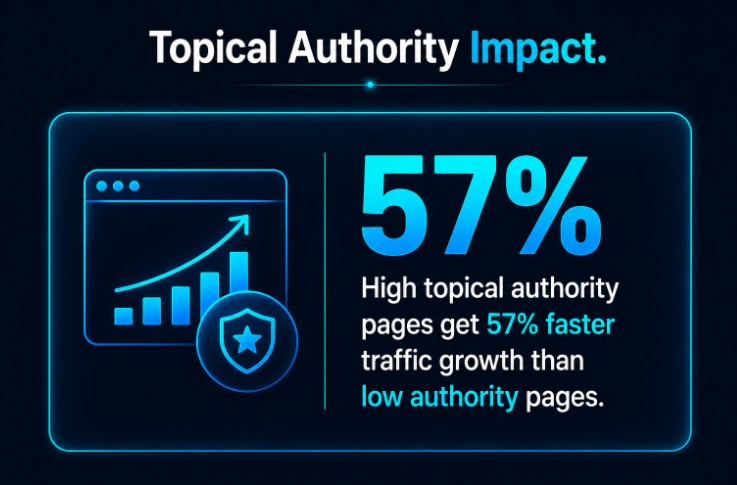
Pages with high topical authority gain traffic 57% faster than those with low topical authority. Assess topical authority by checking the proportion of a site’s content that covers your target subject area.
Source: Graphite
Brand Mentions
Brand mentions generated by digital PR, product reviews, and genuine editorial coverage now carry a signal that pure link-volume metrics miss entirely.
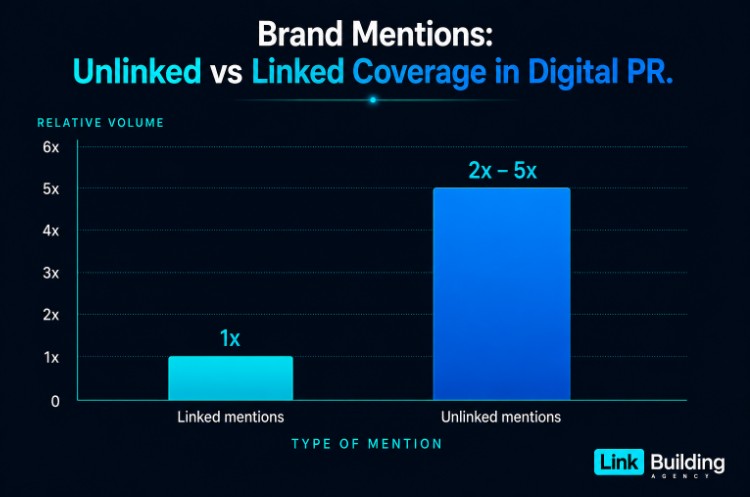
Unlinked mentions can outnumber linked ones by 2x to 5x, and they are a reclamation opportunity.
Source: NewMedia
AI Search Visibility
Generative engine optimisation (GEO) is emerging as a distinct practice from traditional SEO. Tools like Profound, BrandRabbit, and Semrush’s AI Toolkit now track citation frequency across ChatGPT, Perplexity, and Gemini.
Monitoring whether your brand or content appears in AI-generated answers is increasingly a meaningful authority indicator, particularly in informational niches.
URL-Level Authority
Ahrefs’s URL Rating (UR) and Moz’s Page Authority (PA) measure authority at the individual page level rather than the domain level.
For link building, the UR or PA of the specific page that will link to you matters more than the site’s DR or DA.
Content Quality Signals
Original data, clear expertise, named authors, and citations are things no authority score captures, and they matter to both Google and AI citation systems.
Why Modern SEO Requires Multiple Authority Signals
The Backlinko study of 11.8 million search results found that higher domain authority tends to correlate with higher rankings, but the relationship is only moderate and varies significantly at the page level.
The sites that consistently win in competitive SERPs, and increasingly in AI-generated results, combine strong link profiles, deep topical coverage, brand recognition, and clean technical SEO.
How to Improve DR and DA Without Chasing Vanity Metrics
Everything in this section builds genuine authority: the kind that improves your rankings, helps AI systems cite you, and survives algorithm updates.
1. Earn Links Through Digital PR
Digital PR is the single most effective strategy for acquiring high-DR, editorially verified links at scale.
A survey of 518 SEO professionals by Editorial Link found that 48.6% considered digital PR the most effective link-building tactic.
Try this: Run a small survey or analyze your own platform data, package one surprising finding, and pitch it to 30 relevant reporters. Expect roughly an 8.5% reply rate, so volume and relevance both matter.
2. Build Brand Mentions Across the Web
Brand mentions, even without links, still help build authority in Google and AI systems. Focus on getting coverage in publications your audience reads, not just high-DR sites.
When you find unlinked mentions (search your brand name in quotes in Ahrefs Alerts), reach out to request attribution with a link. Conversion rates on these requests are typically high because the journalist already values your brand enough to mention it.
Try this: Answer journalist queries on Connectively and Featured weekly. Each placement is a mention, and many convert to links you can reclaim later.
3. Create Citation-Worthy Content
The content that earns the most links, and increasingly the most AI citations, is content that contains information no other source provides.
That means original data, primary research, proprietary analysis, or a synthesis of existing data presented in a format that makes it easy for journalists and AI systems to reference.
Try this: Publish one definitive, original-data page per quarter, like a statistics roundup or a benchmark study.
4. Develop Topical Authority Clusters
Cover a subject completely, not in scattered posts. Build a pillar page plus supporting articles that interlink, so you become the obvious source for that topic. This can make you crawlable by Googlebot and AI retrieval systems.
Try this: Map ten questions your audience asks, write a hub and ten linked answers, and connect them tightly. Depth signals expertise to both Google and AI engines.
5. Improve Linkable Asset Creation
A linkable asset is a piece of content or a tool that earns links passively over time without ongoing outreach.
For most businesses, linkable assets fall into four categories: data studies and reports, free tools and calculators, definitive reference guides, and visual content (infographics, data visualisations, and original illustrations).
Each category requires investment, but each also compounds over time in a way that paid links never do.
Try this: turn your best spreadsheet into a free interactive tool. A wage calculator, a checklist generator, or a comparison tool earns links no blog post will.
Common Mistakes When Using DR and DA for SEO Decisions
- Using DR or DA as a ranking predictor is misleading; high-DR sites can rank below low-DR sites for the same keyword.
- Rejecting link opportunities based solely on low DR or DA. A DR 25 site that has 45,000 monthly visitors, covers your exact niche, and has a real editorial team is a better link partner than a DR 55 site with 1,200 visitors and a content farm.
- Treating DA and DR as interchangeable. They measure different things, use different datasets, and update on different timelines. Using them interchangeably in reports creates confusion and can lead to bad decisions.
- Ignoring traffic trends misses the bigger picture; a site’s direction over 12–24 months matters more than its current score.
- Assuming DA or DR reflects Google’s trust is incorrect, as penalized sites can still maintain or even grow these metrics.
Authority Metrics Used by Modern SEO Platforms
DR and DA are not the only SEO authority scores. Knowing the others sharpens your backlink quality assessment.
1. Semrush Authority Score
Semrush’s Authority Score (AS) evaluates a domain across three dimensions: backlink quality and quantity, organic search traffic, and spam factors.
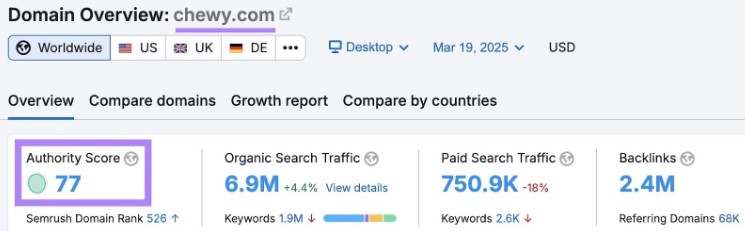
Xamsor’s study found that Semrush AS was the hardest to artificially inflate among the four tools tested (Ahrefs, Moz, Semrush, Majestic).
2. URL Rating
URL Rating (UR) is Ahrefs’s page-level equivalent of DR. It measures the backlink strength of a specific URL, rather than the entire domain.
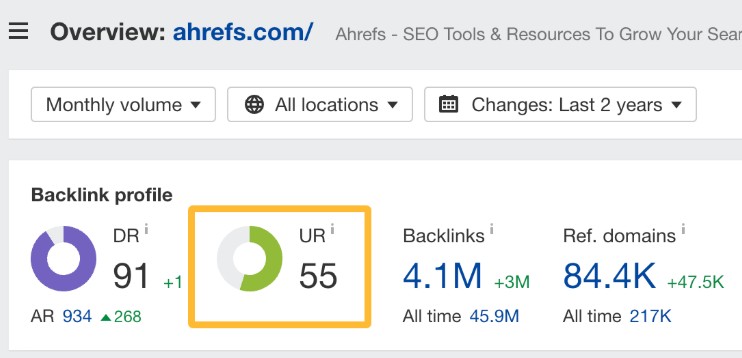
For link building, the UR of the linking page is often a more relevant signal than the site’s DR: a high-DR site with a UR 5 linking page passes limited authority.
3. Page Authority
Moz’s Page Authority (PA) is the page-level equivalent of DA. It uses the same machine learning methodology applied at the URL level.
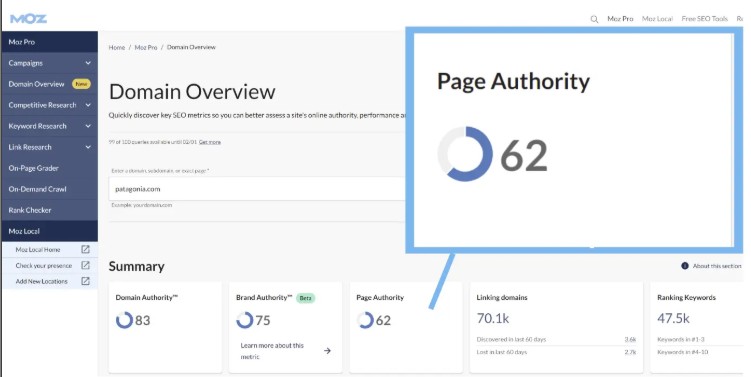
PA is useful for evaluating how much authority a specific page is likely to pass via a link, but it is subject to the same manipulation risks as DA at the domain level.
4. Trust Flow
Majestic’s Trust Flow (TF) measures how close a site is, in terms of link graph distance, to a curated list of trusted seed sites.
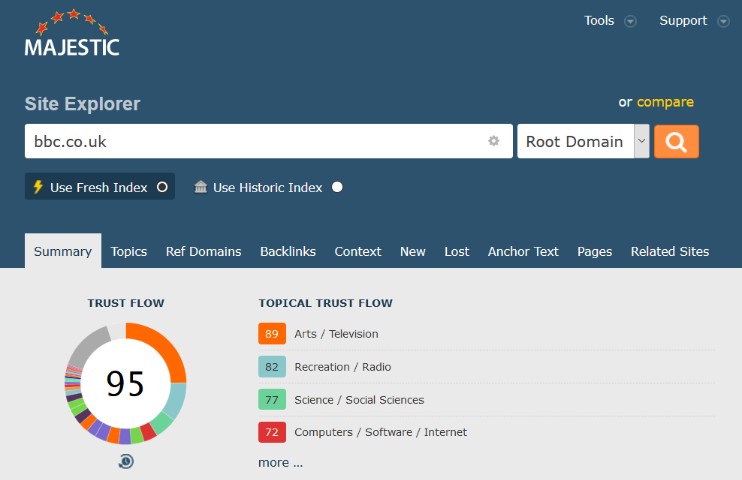
It is considered a strong spam filter because manipulative link networks typically cannot get close to genuinely trusted editorial sources. TF is a useful cross-reference when a site’s DR or DA seems inflated.
5. Citation Flow
Also from Majestic, Citation Flow (CF) measures raw link popularity without quality weighting. The ratio of TF to CF is particularly informative: a healthy editorial site typically shows TF higher than or equal to CF.
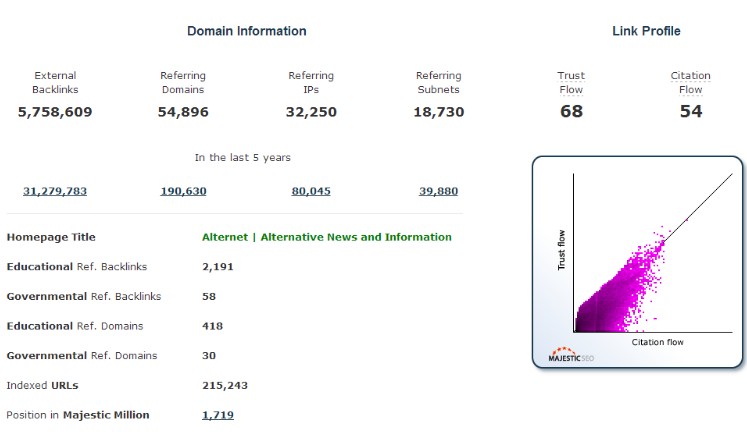
A site where CF significantly exceeds TF has many links, but they are not from trusted sources, a classic manipulation signal.
Our Recommended Authority Evaluation Framework
Rather than relying on any single metric, we use a three -signal check per site and catch the vast majority of manipulated or low-value link prospects.
The 3-Signal Authority Check
- Traffic check: Open the site in Ahrefs or Semrush. Does the organic traffic trend look consistent over 24 months? Is it above 5,000 monthly visits for a DR 40+ site? If not, flag for manual review.
- Relevance check: Does the site cover your target subject area in depth? Are the articles written by real people with expertise? A quick check of the ‘About’ page and a sample of three articles answers this.
On that DR 42 campaign, it’s why we sourced links from relevant sports publications rather than higher-DR sites in unrelated niches.
- Metric sanity check: Do DR and DA roughly agree? Is Trust Flow above Citation Flow in Majestic? Are there any sudden referring domain spikes in Ahrefs history?
If all three points are in the same direction, proceed. If they diverge, investigate further before committing.
How We Evaluate Link Opportunities
For a link opportunity that passes the three-signal check, we then assess:
- URL Rating of the specific page that will host the link
- Whether that page currently ranks for any keywords related to our target topic.
- The anchor text context and whether the surrounding content naturally supports the link
- The outbound link neighbourhood and whether the site links to other credible, topically relevant sources
Domain Rating vs Domain Authority: Which Metric Should You Trust?
Trust both, use neither in isolation. Most importantly, never confuse them with what Google actually measures.
For most SEO workflows, the right approach is to use DR as a first pass filter during link prospecting and organic traffic as the primary quality gate. Use DA and Trust Flow as secondary spam checks, and use topical relevance as the final qualifier.
A site that passes all of those filters is a strong link opportunity regardless of what its DR or DA number says.
FAQs
Neither, on its own. DR is better for fast link prospecting because Ahrefs updates daily. DA is common in client reports. Pick one per task and pair it with traffic and relevance.
Yes, easily. A documented experiment pushed a site from DR 30 to DR 60 in one week for $300 of spam links, and another study hit DR 50 for as little as $15. Always cross-check with traffic.
No. Engines like ChatGPT, Perplexity, and Gemini do not read these scores. They reward retrievable, citable content and brand mentions, which correlate far more strongly with AI visibility than backlinks do.
Yes, low DR/DA sites can rank. There is no fixed good value. It depends on niche and competition, so compare your DR/DA with top-ranking competitors in your space.
Months, not weeks, when done properly. Most digital PR campaigns show measurable results in three to six months. The climb gets steeper as your score rises, because both scales are logarithmic.
Usually no. Google can ignore most spam automatically, and John Mueller has long advised against fearful disavowing. Only disavow if you bought links or received a manual action tied to them.