94% of AI citations come from earned media, not from brand-owned content or paid placements.
That single number explains why digital PR budgets doubled in three years, why 66.2% of practitioners now track AI citations as a KPI that did not exist 18 months ago, and why the conversation has shifted from “how many links did we get?” to “are we showing up when AI answers the question?”
Getting featured in major publications is no longer the hard part. Turning those mentions into rankings, authority, and AI visibility is where most campaigns still break down.
That gap is what makes digital PR the central visibility strategy of 2026, not a supporting tactic, but the connective layer between media coverage, search performance, and long-term brand authority.
Key Digital PR Statistics 2026: Top Picks
- 94% of AI citations come from earned media sources, not paid or brand-owned content.
- 34% of SEOs rank digital PR as their #1 best-performing link-building method.
- 85.2% of digital PR campaigns produce measurable results within 3 to 6 months.
- 73.6% of PR professionals use AI for campaign ideation.
- 66.2% of practitioners now track AI citations as a KPI.
- The digital PR services market is projected to hit $25.4 billion in 2032, up from $12.3 billion in 2023.
The State of Digital PR in 2026
The digital PR industry has crossed a tipping point. It is no longer an experimental tactic for SEO teams. The market size data, adoption figures, and search trend data all point in one direction: mainstream.
| 85.8% Professionals say digital PR is most effective for backlinks | 76% PR professionals use generative AI in their daily work | 95.9% Practitioners use data-led campaigns as a primary strategy |
Digital PR Adoption in 2026: How Widely It’s Being Used
- 45.6% of SEOs currently use digital PR as a link-building method, making it the most widely adopted strategy in the industry.
Source: Reporter Outreach
- 67.3% of marketers use digital PR for link-building specifically, ranking it the most popular method among all the acquisition strategies.
Source: Reboot Online
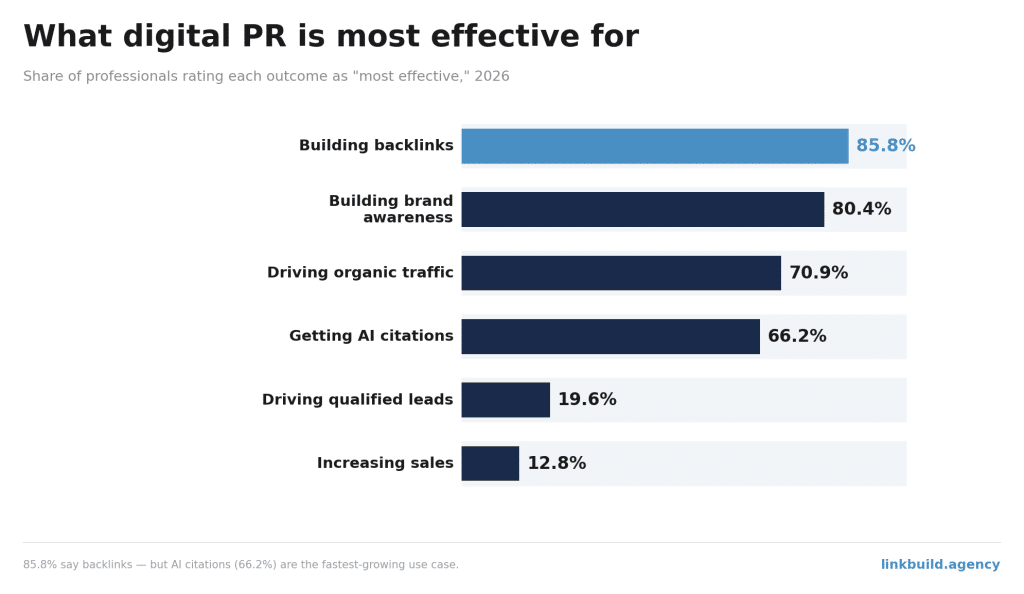
- According to a survey done by BuzzStream, 85.8% of professionals believe digital PR is the most effective strategy for building backlinks, reflecting a rare consensus in an industry that rarely agrees on anything.
| Strategy | Effectiveness of Strategy (%) |
|---|---|
| Building backlinks | 85.8% |
| Building brand awareness | 80.4% |
| Driving organic traffic | 70.9% |
| Getting mentioned in AI citations | 66.2% |
| Driving qualified leads | 19.6% |
| Increasing sales | 12.8% |
Source: BuzzStream
- According to Muck Rack’s report “State of AI in PR 2026,” 76% of PR professionals now use generative AI in their daily work.
Source: Muck Rack
- Data-led campaigns dominate digital PR activity and are used by 95.9% of practitioners as their primary approach.
Source: BuzzStream
At 45.6% adoption among SEOs and 67.3% among marketers broadly, digital PR is no longer an edge tactic. If your competitors are in either of those groups, they are already building the backlink and citation profile you are not. .
Is Digital PR Replacing Traditional Marketing in 2026?
- Over 60% of PR teams now allocate a portion of their traditional PR budget to digital channels.
Source: Reporter Outreach
- Traditional PR retainers average $10,000 to $14,500 per month, while digital PR retainers average $5,000 to $10,000 per month.
Source: BuzzStream
The shift is not just about cost. Traditional PR placements generate zero direct link equity or ranking benefit. On the other hand, digital PR coverage earns backlinks, referral traffic, and AI search citations all at once.
- 81% of PR teams now participate in cross-functional marketing meetings, a dramatic shift from just a few years ago, when only 18% of PR companies were closely integrated with marketing teams.
The budget migration is straightforward: traditional PR cannot attribute a media hit to a ranking improvement, a referring domain, or an AI citation. Digital PR can.
That measurability gap is closing the argument faster than any thought leadership article ever could.
How Effective Is Digital PR for Link Building in 2026?
When evaluating digital PR, effectiveness is the key metric that matters most when making an internal case for investment.
| 34% SEOs rank digital PR as their #1 best-performing method | 85.2% Campaigns show measurable SEO results within 3–6 months | 48.6% SEOs rate digital PR as the most effective link-building strategy |
- 34% of the SEOs rank digital PR as their #1 best-performing method, nearly double the next closest tactic, guest posting at 18%. And when you add journalist sourcing/HARO methods into the PR bucket, the combined figure reaches 55%.
Source: Reporter Outreach
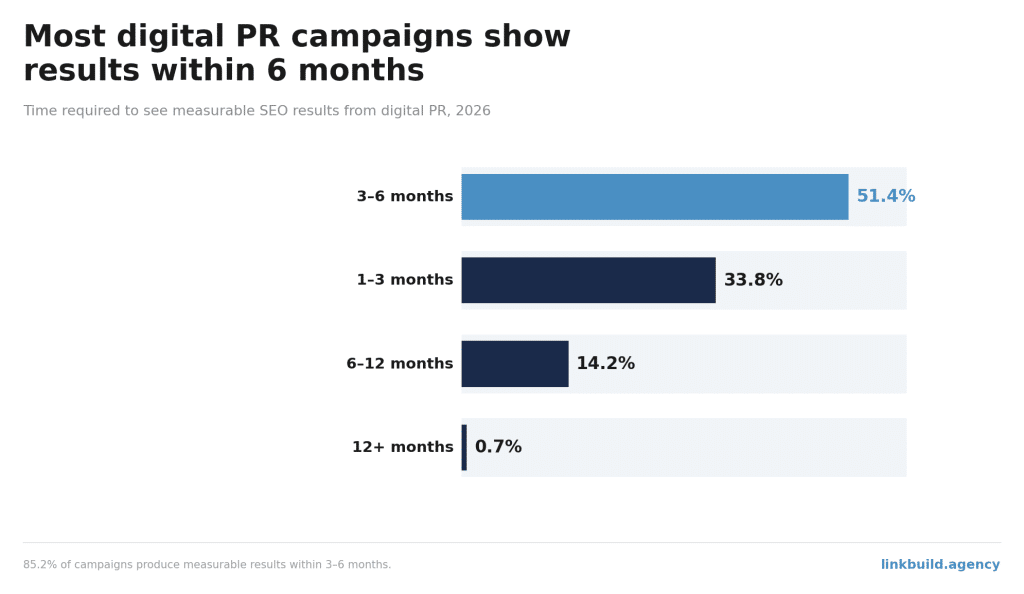
- 85.2% of campaigns produce measurable SEO results within the first 6 months.
| Period | Share of Measurable results |
|---|---|
| 1-3 months | 33.8% |
| 3-6 months | 51.4% |
| 6-12 months | 14.2% |
| 12 months+ | 0.7% |
Source: BuzzStream
- 48.6% of SEO professionals rated digital PR as the most effective link-building strategy.
Source: Editorial.link
The data consistently points out that digital PR has established itself as the most effective and widely trusted link-building approach in 2026.
This is primarily because it delivers high-quality editorial backlinks at scale while also producing measurable SEO impact within relatively shorter timeframes.
Link Acquisition Benchmarks: How Many Links Does Digital PR Actually Earn
Link acquisition benchmarks show what realistic performance looks like for digital PR campaigns. If you plan properly, they can help you set clear goals, align expectations, and evaluate success more effectively.
| 42 Average unique referring domains per digital PR campaign | 7.83% Backlinks come from DR 90+ domains | 33.79% Increase in open rates with personalized pitch subject lines |
- The average campaign earns a link from 42 unique referring domains. Top performers in major media cycles earn significantly more.
Source: Reporter Outreach
- More than 20.62 earned backlinks sit in the DR 70-79 range. Around 1 in 13 (7.83%) sit at a DR 90 or above. This represents 27.8% more than those with a DR below 30.
Source: Reboot Online
- 48% of digital PR backlinks from 2024 generated a follow link, compared to around 33% syndicated ones. Around 19% were nofollow.
Source: Reboot Online
- Only 1 in 3 pitches gets opened by journalists. Personalized subject lines see 33.79% higher open rates than templated ones. It means your story quality matters far less if your pitch does not get read.
Source: BuzzStream
A single campaign with a strong data angle and targeted pitching can realistically deliver 20+ editorial links from DR 50+ publications.
But the pitch open rate stat deserves more attention than most people give it: if two-thirds of journalists never read your email, even a great story dies in the inbox.
Cost of Digital PR in 2026: Budget, Pricing & Cost Per Link
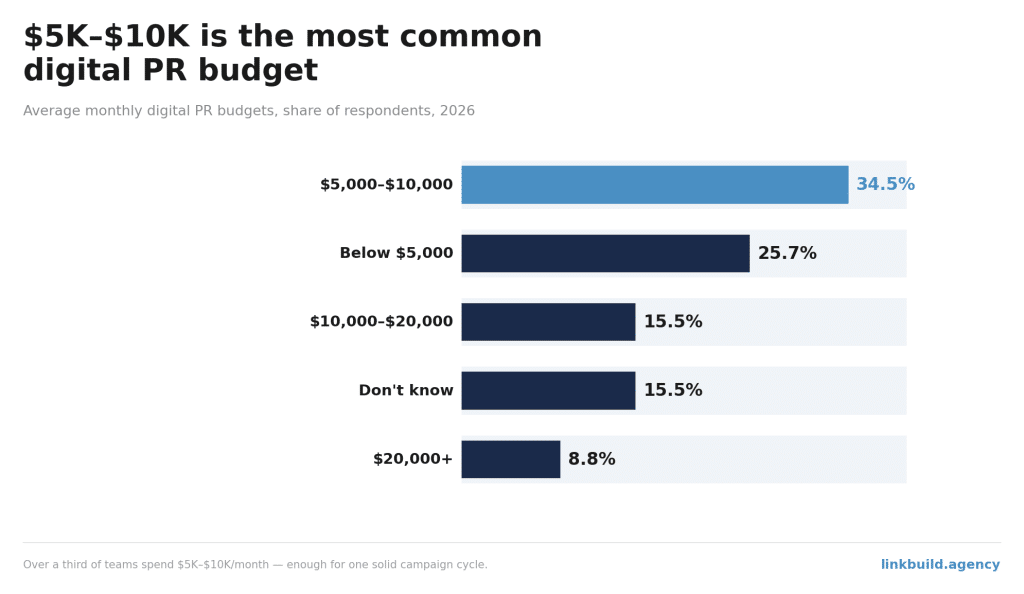
Budget questions are the ones clients and internal stakeholders ask most. Here is the full list of average monthly digital PR budgets.
| $5,000–$10,000 Most common monthly digital PR budget range | $508.95 Average cost of a high-quality backlink | 80.9% Link builders expect costs to increase in the next 2–3 years |
| Budget Size | % of respondents |
|---|---|
| Below $5,000 | 25.7% |
| $5,000-$10,000 | 34.5% |
| $10,000-$20,000 | 15.5% |
| $20,000+ | 8.8% |
| I don’t know | 15.5% |
Source: BuzzStream
- The average cost of one high-quality backlink is around $508.95, according to a survey of 518 SEO professionals done by Editorial Link.
Source: Editorial.link
- The industry average cost per earned link sits around $750, with 44.7% of SEOs paying $300 or more per placement.
Source: BuzzStream
- 80.9% of link builders predict costs will keep climbing over the next 2 to 3 years.
Source: Editorial.link
- 38% of CEOs are directly responsible for controlling and allocating the PR budget.
Source: Redline
A budget of $5,000 to $10,000 per month is enough to run one solid campaign with realistic expectations of 20+ links from DR 50+ publications.
Digital PR vs Other Link Building Tactics (2026 Cost Comparison)
Most link-building tactics target the DR 30-50 range. Getting consistent DR 60+ placements at scale is something very few strategies can deliver. Over 20% of digital PR backlinks come from DR 70-79 sites.
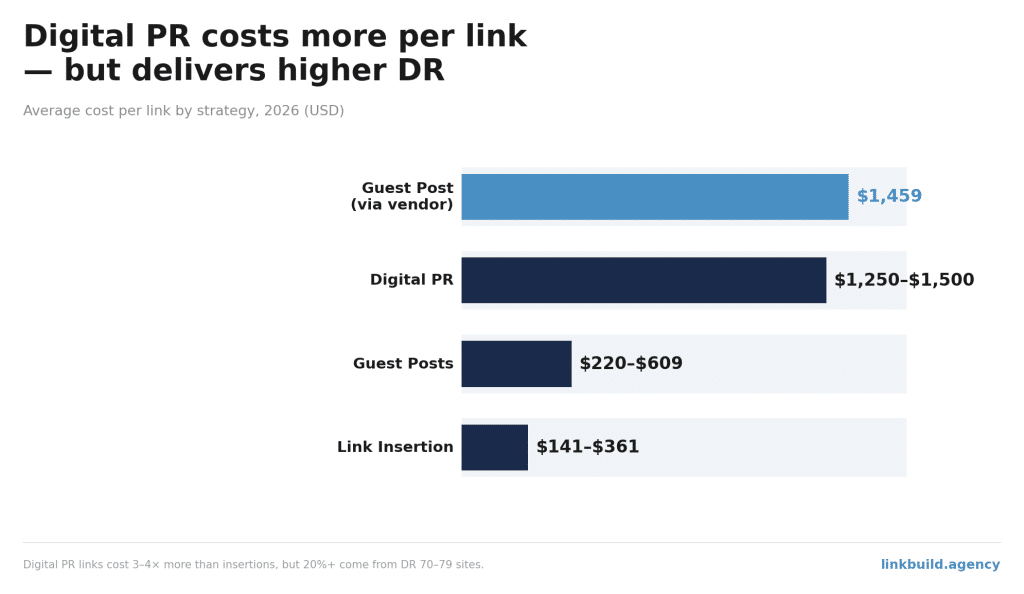
- Digital PR links via agencies cost roughly $1,250 to $1,500 per link when broken down by placement.
This is higher than the average $508.95 standalone backlink acquisition cost because digital PR pricing also includes campaign strategy, creative assets, journalist outreach, and media relations.
| Strategy | Value |
|---|---|
| Digital PR | $1,250-$1,500 |
| Guest Posts | $220-$609 |
| Guest Post through vendor | $1,459.06 |
| Link Insertion | $141-$361 |
Source: LBHQ, BuzzStream
ROI of Digital PR: Traffic, Rankings, and Revenue Impact
Although attribution in digital PR is difficult, its impact can often be measured through improvements in traffic, search visibility, backlinks, and brand awareness.
| 10%–40% Increase in branded searches after media coverage | 3.8× More backlinks on top-ranking pages | 22.5% Use referring domains as the primary KPI for success |
- Strong media coverage can increase branded searches by 10% to 40% within a few weeks and drive a 5% to 20% rise in direct traffic within 72 hours after publication.
Source: Newmedia
- Top-ranking pages on Google usually have 3.8x more backlinks and 2.3x referring domains than lower-ranking pages. This is why digital PR can deliver strong long-term SEO value.
Source: Backlinko
- 22.5% of digital PR specialists use an increase in referring domains as their primary KPI for success. 19% use ranking improvements and 13% track referral traffic.
Source: uSERP.io
- Positive media coverage, when paired with consistent messaging, can improve brand favorability by approximately 5% to 18% over a quarter. Similarly, gains of 5 to 20 share-of-voice points are often associated with stronger brand recall.
Source: Newmedia
Digital PR ROI compounds slowly. In a month, you may see a traffic spike and some new links. By 12 months, if campaigns are consistent, the referring domain growth and ranking improvements become very hard to ignore.
Is Digital PR Worth It for SEO and Branding?
Yes, digital PR is worth it for most brands. But it depends heavily on execution quality and time horizon.
| 93.8% Prioritize link quality and relevance over volume | 92.3% Top 100 ranking websites have at least one backlink | 10%–35% Increase in qualified job applications |
- 93.8% of link builders now prioritize quality and topical relevance over volume. This shift toward quality has actually made digital PR more attractive, since it produces exactly the type of high-authority, editorially earned links that Google rewards.
Source: Amra & Elma
- 92.3% of the top 100 ranking websites have at least one backlink, and links from high-authority domains are strongly associated with better search rankings.
Source: Semrush
- Consistent earned media coverage can improve reputation over time, often reducing negative mentions by 10% to 30% through steady narrative building.
Source: Newmedia
- Blogs receive 97% more links from external sites compared to non-blogging websites. This reinforces the importance of combining content and PR by ensuring there is valuable material for journalists to reference and link to.
Source: HubSpot
- Credible media coverage can also strengthen employer branding, increasing qualified job applications by 10% to 35% in the following month, a benefit often overlooked in ROI calculations but highly valuable.
Source: Newmedia
Brand Mentions vs Backlinks: The New SEO Currency in 2026
Backlinks still matter. But campaigns generating both backlinks and brand mentions are now outperforming those that chase only one, particularly in AI search.
| 0.664 Correlation of brand mentions with AI Overview presence | 94% AI citations come from non-paid, earned sources | 66.2% Practitioners track AI citations as a KPI |
Digital PR is uniquely effective in this way because every editorial placement naturally includes both.
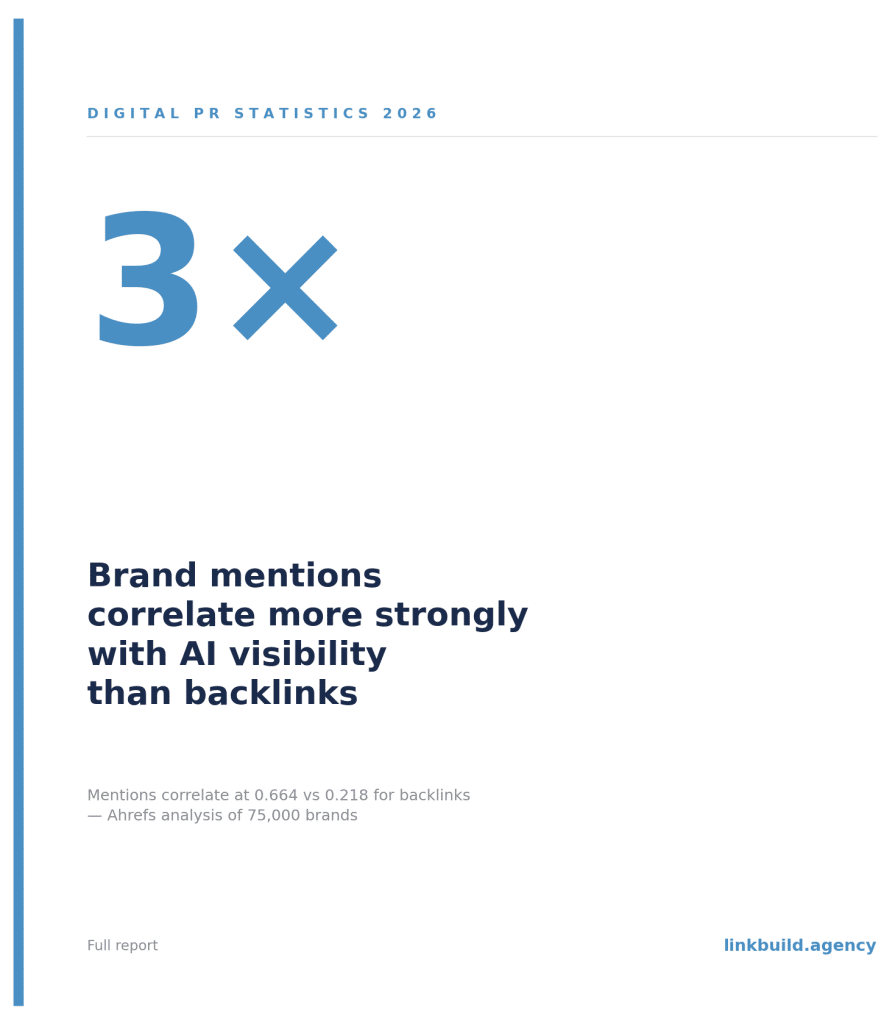
- Branded web mentions correlate with AI Overview presence at 0.664. Backlinks correlate at 0.218. That is a 3x difference shown in the finding from Ahrefs’ analysis of 75,000 brands.
Source: Ahrefs
“Citations are the new backlinks for the AI era, marking what some describe as the era of off-page SEO.” – Tim Soulo, Ahrefs CMO
Source: Search Engine Journal
- 94% of AI citations come from non-paid, non-brand-owned sources, meaning earned media.
Source: Muck Rack
- Brands are 6.5x more likely to be cited through third-party sources than through their own domains in AI search.
Source: AirOps
- Distributing content across a wide range of publications increases AI citations by up to 325%.
Source: Stacker
- Half of all AI citations come from content published within the last 11 months, with approximately 4% from the prior week.
Source: SuperPrompt
This means mention velocity, the rate at which new earned coverage accumulates, is a critical ongoing metric, not a one-time achievement.
- 66.2% of practitioners now track AI citations as a KPI, a new metric of 2026 that has resulted in fast adoption.
Source: BuzzStream
Digital PR in Local SEO: Impact on Rankings and Map Packs
Local businesses often underestimate how much digital PR can move local search rankings. The data on local pack placement makes the business case very clear.
| 126% More traffic from Google 3-Pack listings | 42% Share of clicks from Google Map Pack results | 993 Average backlinks for businesses in local map pack rankings |
- Businesses in the Google 3-Pack receive 126% more traffic and 93% more conversion-oriented actions like calls and website clicks than businesses ranked in positions 4 to 10.
Source: Search Engine Land
- Around 42% of local searches result in a click on the Google Map Pack. The Map Pack also accounts for roughly 44% of local search interactions (including clicks, calls, and direction requests).
- 40% of local business queries now trigger Google’s AI Overviews. This means local digital PR and earned media now influence AI-generated local answers too.
Source: LocalFalcon
- Local backlinks authority still influences local organic rankings. An average business in the local map pack has 993 backlinks and 216 referring domains. Local digital PR can directly contribute to closing this gap.
Source: Semrush
- 45% of consumers now use ChatGPT or other generative AI tools for local business recommendations.
Source: BrightLocal
For local businesses, digital PR has two main benefits. First, local media coverage builds local backlinks and referring domains that are directly relevant to the local pack algorithm.
Another way is that earned mentions in local news and regional publications increasingly feed AI-generated local answers.
Digital PR and AI Search (GEO): How Statistics Influence AI Citations
This is the fastest-moving area in digital PR right now. The generative engine optimization (GEO) shift means digital PR now serves traditional search engines along with AI citation engines.
| 2B Monthly users reached by Google AI Overviews | 74% SEOs believe backlinks influence AI search visibility | 79.1% Use press releases in digital PR campaigns (2026) |
- Google AI Overviews now reaches 2 billion monthly users across 200+ countries. Google’s AI Mode hit 100 million monthly users in the US and India.
- 74% of SEOs believe backlinks impact AI search visibility, yet only 24% actively track them. This gap between belief and measurement is where the competitive opportunity currently sits.
- Only 19% of SEOs have adjusted their approach for AI search, 34% plan to, and 47% have not changed anything.
Source: Reporter Outreach
- Pages with quality scores above 0.70 and 12+ structural signals achieve a 78% cross engine citation rate across AI platforms.
Source: arXiv
- AI is increasingly used in Digital PR ideation and analysis, with 73.6% of professionals using it for campaign ideation, contributing to faster and more efficient development of data-led concepts.
- Press release usage jumped to 79.1% in 2026, up from 68.8% the year prior, partly because structured press releases are easier for AI systems to parse and cite.
Source: BuzzStream
The same authoritative, data-driven campaign that gets a journalist to link to you is also the type of content AI engines cite. That is not a coincidence; both systems reward third-party validation and structured, source-backed claims.
What Types of Digital PR Campaigns Earn the Most Links
Not all digital PR campaigns are the same, and some formats significantly outperform others.
| 95.9% Experts use data-led campaigns for the highest link volume | 39.6% Share of US media articles that are data-driven | 178% Increase in backlinks from infographics compared to text posts |
- Data-led campaigns are the top-performing format, used by 95.9% of experts and consistently producing the highest link volume. They are the only campaign type that makes journalists self-sufficient, as they have the story and proof in one place.
Source: BuzzStream
- Data-driven campaigns made up nearly 2 in 5 articles (39.6%) in the US media analysis. This is twice as many as mapped campaigns (19.7%) or surveyed pieces (19.4%).
Source: Reboot Online
- Expert commentary is the most utilised PR tactic at 95.3%. It is fast to produce and relevant to breaking news cycles, but it rarely earns as many links as proprietary data.
Source: BuzzStream
- Infographics can boost backlinks by 178% compared to standard text posts. Companies using video on blogs receive 55% more backlinks.
Original survey data works best in practice. This means collecting responses from 1,000 or more people on a topic relevant to your industry.
When your brand is the only one publishing that data, other articles tend to cite and link back to it. This creates long-term, compounding value that paid links cannot replicate.
Common Failures in Digital PR Campaigns (and What the Data Shows)
Most digital PR campaigns do not fail because the strategy did not work. They fail because of specific, avoidable execution mistakes.
| 26.4% Securing media coverage is the top challenge | 94% Of the content earns zero backlinks | 39.2% Do not track the cost per link |
- Getting coverage is the leading challenge for digital PR professionals (26.4%), followed by measuring impact (14.9%) and keeping up with industry changes (14.2%).
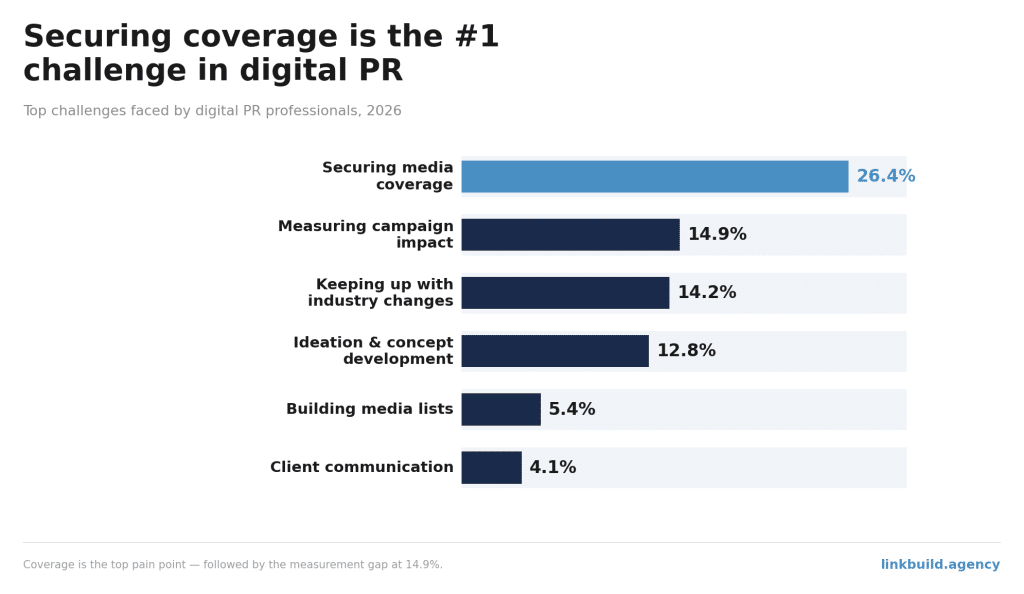
| Key Challenge Area | Share of Respondents |
|---|---|
| Securing media coverage | 26.4% |
| Measuring campaign impact | 14.9% |
| Keeping up with industry changes | 14.2% |
| Ideation and concept development | 12.8% |
| Building media lists | 5.4% |
| Client communication | 4.1% |
| Data collection | 3.4% |
| Maintaining media lists | 2.0% |
| Others | 16.8% |
Source: BuzzStream
- Only 6% of published content earns even a single backlink, which means 94% have zero backlinks.
Source: Backlinko
- 39.2% of professionals do not track their cost per link. Without this number, proving ROI is nearly impossible.
Source: BuzzStream
The pattern across most campaign failures is the same: the idea is too generic, the pitch is too templated, or the story lacks proof. Journalists receive hundreds of pitches per week.
They delete anything that does not immediately signal relevance and value. If your subject line is “Exciting research from [Brand Name],” your campaign has already failed before anyone reads it.
Can You Do Digital PR Without an Agency?
Yes, but with real trade-offs. Here is what the data says about in-house digital PR.
- 56% of respondents outsource at least part of their link-building tasks, while 44% handle everything in-house.
Source: Editorial.link
- 83% of digital PR professionals rely on media databases to find journalists.
Source: Reboot Online
- PR platform subscriptions from tools like Prowly, Cision, and Muck Rack run $10,000 per year for the direct-access option. These work if someone internally has the time and skill to manage outreach consistently.
Source: Prowly
Agencies bring established media relationships, deep expertise, and speed. In-house teams offer tighter brand control and lower long-term costs but require consistent internal ownership and a specific skillset that is rare.
What These Statistics Mean for Your Digital PR Strategy in 2026
- Prioritize brand mentions alongside backlinks. If you are optimizing only for link count, you are optimizing for one of the two AI visibility signals.
- Track AI citations regularly. 66.2% of practitioners already do. The 47% who have not changed anything for AI search are operating as if Google AI Overviews does not reach 2 billion people.
- Use data as your primary campaign format. 95.9% of professionals already use it because it works. Proprietary surveys and original data studies are the most reliable way to earn consistent placements at DR 50+.
- Track cost per link. 39.2% do not. Without this number, you cannot prove ROI, justify budget, or improve campaign efficiency over time.
- Commit to at least 6 months. 85.2% of campaigns produce measurable results in 3 to 6 months.
Future Trends: Where Digital PR Is Heading Beyond 2026
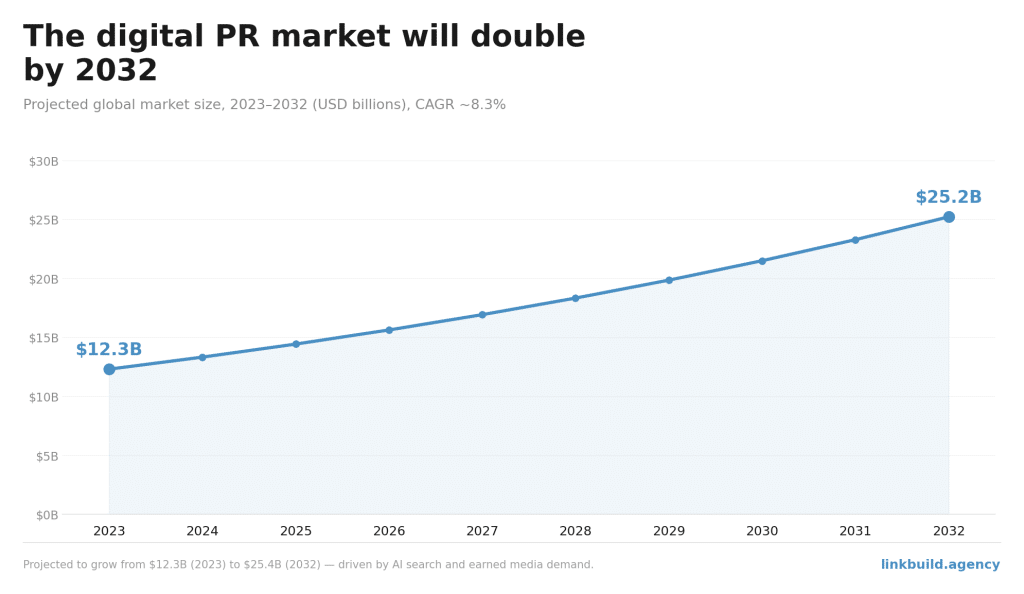
The digital PR market is projected to reach $25.4 billion in 2032, more than doubling from $12.3 billion in 2023, at a CAGR of approximately 8.3%.
AI-powered campaign ideation tools will compress research time further. Teams using AI for ideation report faster turnaround. But AI does not replace journalist relationships, which remain the irreplaceable variable.
Creator-led PR is entering the mainstream. 64% of PR campaigns now feature creators or influencers as a core strategy. It delivers an average return of $5.78 for every $1 spent, making creator partnerships one of the highest-ROI digital channels.
The direction of digital PR beyond 2026 is toward measurement, AI integration, and earned authority as the primary signal for both traditional and AI search.
Source: Reboot Online, Influencer Marketing Hub